Cattle Feed Pelleting Mills in Shenzhen
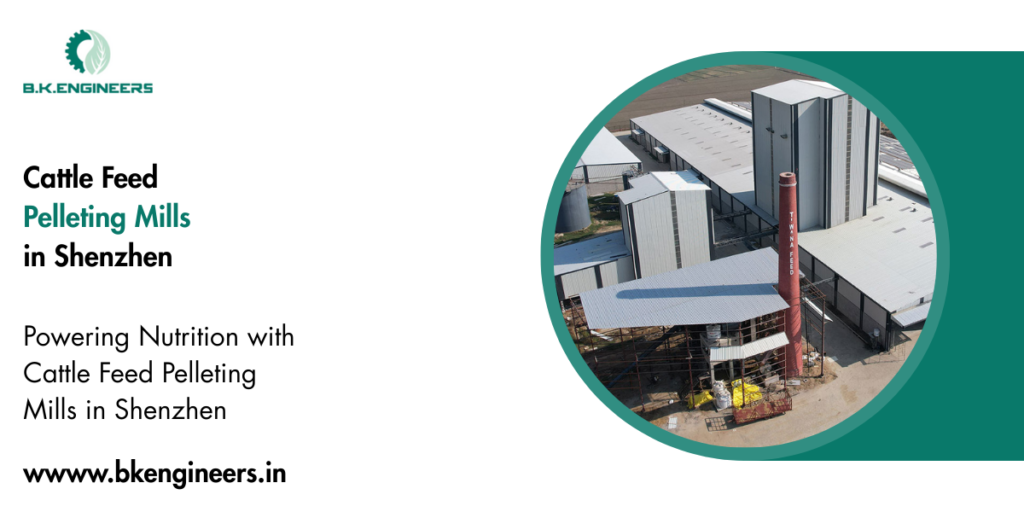
Table of Contents
Introduction
At B.K. Engineers, we specialize in manufacturing a wide range of mills designed to meet your diverse needs. Our expertise spans across Cattle Feed Mills, Poultry Feed Mills, Aquatic Feed Mills, Bran Pelleting Mills, Hull Pelleting Mills, Grass Pelleting Mills, Alfalfa Pellets Mills, Wood Pellets Mills, and Straw Pelleting Mills. With our state-of-the-art technology and commitment to quality, we ensure that you get the best equipment for your production needs.
Over the past ten years, Shenzhen’s livestock farming has seen a significant transition. Farmers are using cutting-edge technologies to improve feed efficiency and animal health in response to the growing demand for premium meat, milk, and dairy products. Cattle Feed Pelleting Mills are one such invention that is causing a stir in the market, and B.K. Engineers are leading the way in offering state-of-the-art solutions for Shenzhen’s livestock industry.
The three main pillars of success in the contemporary cattle sector are cost-effectiveness, quality, and efficiency. Good cattle feed is one of the most important components of this ecosystem. Purchasing cutting-edge cattle feed pelleting mills is a game-changer for Shenzhen’s farmers and livestock business owners. Top-tier pelleting mills from B.K. Engineers, a top producer of feed processing equipment, are intended to increase feed efficiency, promote livestock health, and optimise earnings. We are the best Cattle Feed Pelleting Mills Manufacturer.
Understanding Cattle Feed Pelleting Mills
A device called a Cattle Feed Pelleting Mill is used to turn powdered animal feed into small pellets. Cattle can more easily store, carry, and—most importantly—digest these pellets. Pelletized feed, as opposed to traditional feed, guarantees consistent nutrition, lowers waste, and improves growth performance. B.K. Engineers, a top producer of feed pelleting equipment, has been providing the Shenzhen market with specialised solutions made to satisfy the needs of contemporary livestock farming. Their equipment is made to minimise energy use and operating expenses while maximising feed quality. We are the best Cattle Feed Pelleting Mills Supplier.
Why Choose B.K. Engineers
1. Advanced Technology and Innovation
- Shenzhen is known for its cutting-edge manufacturing and engineering capabilities. Cattle feed pelleting mills produced here incorporate the latest technology in feed processing, including precision grinding, high-efficiency pellet formation, and automated control systems. These mills ensure consistent pellet size, density, and nutritional integrity, which directly improves feed intake and digestibility for cattle.
2. High Efficiency and Cost Savings
- Efficiency is a key factor in modern feed production. Shenzhen pelleting mills are designed to process large volumes of feed in less time while consuming minimal energy. Features such as optimised die and roller designs, advanced motor systems, and intelligent temperature control reduce operational costs and increase overall productivity. Farmers benefit from faster feed preparation, lower electricity consumption, and reduced wastage of raw materials.
3. Durability and Reliability
- Shenzhen’s feed milling equipment is manufactured using premium-grade steel and high-quality components, ensuring long-term durability and minimal maintenance requirements. These machines are built to withstand continuous operation in demanding environments, making them a reliable investment for livestock farmers. Regular maintenance is simple, and replacement parts are easily available, minimising downtime and operational disruptions.
4. Customizable Solutions for Diverse Needs
- Every farm has unique requirements based on herd size, feed composition, and production scale. Shenzhen feed mill manufacturers offer a wide range of customizable options, from small-scale portable pelleting mills to fully automated large-scale industrial units. Users can choose equipment tailored to specific needs, including adjustable pellet sizes, moisture control systems, and integrated cooling mechanisms to ensure optimal feed quality.
5. Enhanced Feed Quality and Animal Performance
- The ultimate goal of any feed processing operation is to improve animal nutrition and performance. Cattle feed pelleting mills in Shenzhen are designed to preserve nutrients during processing, reduce feed wastage, and improve pellet hardness and stability. Consistent, high-quality pellets support better digestion, promote weight gain, and enhance milk and meat production, directly benefiting farm profitability.
6. Excellent After-Sales Service and Technical Support
- Manufacturers in Shenzhen are known for providing strong after-sales support, including installation, operation training, and troubleshooting assistance. Many suppliers offer remote monitoring systems, spare parts availability, and maintenance guidance, ensuring that the cattle feed pelleting mill operates at peak performance throughout its lifespan. This level of support gives farmers confidence in their investment and reduces operational risks.
7. Competitive Pricing and Global Export Experience
- Shenzhen combines high-quality manufacturing with competitive pricing. The region’s export-oriented production ensures that equipment meets international standards, including CE, ISO, and GMP certifications. Buyers can access world-class cattle feed pelleting mills at reasonable prices, making Shenzhen an attractive sourcing destination for both domestic and international livestock producers.
8. Sustainability and Energy Efficiency
- Modern cattle feed pelleting mills from Shenzhen often integrate eco-friendly technologies, such as energy-efficient motors, dust collection systems, and low-noise designs. These features reduce environmental impact while saving operational costs, aligning with sustainable farming practices and modern regulatory requirements.
9. Cost-Effective and Competitive Pricing
- Despite their high quality and advanced features, Shenzhen’s pelleting mills are competitively priced. The region’s robust manufacturing ecosystem allows for cost-effective production without compromising on performance. This makes it easier for businesses to get top-tier machinery at a reasonable investment.
10. Environmentally Friendly Operations
- Many Shenzhen pelleting mills are designed with energy efficiency and sustainability in mind. They reduce feed wastage, optimise pellet size, and often use low-energy motors, helping farms minimise environmental impact while maintaining high-quality feed production.
11. Trusted by Global Clients
- Shenzhen has a long-standing reputation in the agricultural machinery sector, supplying pelleting mills to farms and feed producers worldwide. Their equipment meets international standards for quality, safety, and performance, making them a reliable choice for anyone looking to improve feed efficiency and animal health.
Applications of Cattle Feed Pelleting Mills
1. Dairy Cattle Nutrition
- Pelleted feed is an excellent source of balanced nutrition for dairy cows. The feed ensures proper intake of proteins, vitamins, and minerals, which are essential for milk production. Pelleting prevents selective feeding, ensuring cows consume all nutrients uniformly.
2. Beef Cattle Growth
- For beef cattle, growth rate and weight gain are critical. Pelleted feed produced using B.K. Engineers’ mills promote better digestion and absorption of nutrients, resulting in healthier and faster-growing livestock.
3. Feed Manufacturing Industry
- Pelleting mills are widely used in commercial feed plants. They allow manufacturers to produce high-quality feed for various types of cattle, reducing feed wastage and improving profitability.
4. Farm-Based Pellet Production
- Small and medium-scale farms in Shenzhen and surrounding regions often use pelleting mills to process leftover grains, silage, and other agricultural by-products into feed pellets. This not only reduces waste but also ensures cost-effective feeding.
5. Speciality Feed Production
- Modern pelleting mills support the production of specialised feed for different life stages of cattle — from calves to mature cows. With precise control over feed composition and pellet size, farmers can target specific nutritional requirements.
6. Mixed Livestock Farms
- Many farms raise multiple types of livestock, including goats, sheep, and buffalo, alongside cattle. B.K. Engineers’ pelleting mills can process different feed formulations, making it easy to produce specialised pellets for each type of animal.
7. Commercial Feed Production
- Beyond farm-level applications, pelleting mills are crucial in commercial feed production units. These mills can handle large-scale production, ensuring consistent pellet quality for distribution to local farms and agricultural markets.
8. Reduced Feed Waste
- Loose feed often leads to wastage, as animals spill, trample, or selectively consume certain parts. Pelleted feed reduces such wastage, ensuring more efficient use of resources. For farms in Shenzhen, where space and feed costs are significant considerations, this efficiency can translate into substantial savings.
9. Longer Shelf Life
- Pellets are less prone to moisture absorption and microbial contamination compared to powdered feed. This enhances the storage life of feed, allowing farms and manufacturers to produce in bulk and store for extended periods without compromising quality. B.K. Engineers’ mills produce pellets with optimal density and moisture content to ensure durability during transportation and storage.
10. Versatile Feed Production
- Cattle feed pelleting mills are not limited to feed for cows alone. The same machines can process feeds for other livestock such as goats, buffalo, and sheep. This versatility allows farmers in Shenzhen to diversify their operations without investing in separate machinery.
Specification Table of Cattle Feed Pelleting Mills
| Specification | Details |
|---|---|
| Material | Cattle Feed Pelleting Mills |
| Capacity | 500–3000 kg/h |
| Power | 22–110 kW |
| Pellet Diameter | 2–8 mm |
| Material Type | Stainless steel / Carbon steel |
| Motor Type | Electric / Diesel options |
| Die Type | Flat / Ring |
| Dimensions (L×W×H) | 2–6 × 1–3 × 1.5–3 m |
| Weight | 800–5000 kg |
| Application | Cattle, livestock, poultry feed |
Benefits of Cattle Feed Pelleting Mills
1. Improved Feed Utilisation and Cattle Growth
- One of the core benefits of pelleted feed is its superior digestibility. Pellets are easier for cattle to chew and digest compared to loose mash. As a result:
- Cattle convert more nutrients into muscle and body mass.
- Feed conversion ratio (FCR) improves, meaning less feed is needed for the same growth output.
- Livestock reach market weight faster, boosting overall productivity.
2. Reduced Feed Waste and Better Farm Economics
- Loose feed has a tendency to scatter, settle, and degrade — leading to significant waste. Pelleted feed, however, stays intact and resists the separation of ingredients. This produces:
- Less feed is spilt or wasted during feeding.
- More consistent consumption patterns among cattle.
- Lower overall feed costs.
3. Enhanced Feed Hygiene and Animal Health
- Pelleting involves heat and pressure, which can significantly reduce harmful bacteria, moulds, and pathogens present in raw ingredients. Health benefits include:
- Lower risk of digestive illnesses.
- Better immunity and overall cattle wellness.
- Reduced reliance on antibiotics and additives.
4. Versatility and Processing Flexibility
- Modern pelleting machines can process a wide range of feed types. Whether the diet includes grains, protein meals, vitamins, or minerals, pelleting allows precise formulation and consistency. This versatility ensures that cattle diets meet specific nutritional goals, whether for weight gain, milk production, or maintenance.
5. Time‑Saving Automation and Production Efficiency
- B.K. Engineers’ pelleting mills are designed with automation in mind. Features such as:
- Automatic ingredient feeding
- Programmable controls
- High throughput capacity
6. Easier Storage, Handling & Transport
Pellets are denser and more compact than loose feed mixes. This means:
- Storage takes up less space, ideal for both on‑farm silos and centralised feed mills.
- Reduced dust and debris, which leads to a cleaner production and feeding environment.
- Simplified logistics for transportation to cattle operations or distributors.
7. Customizable Formulation for Targeted Nutrition
Pelleting mills give producers the flexibility to tailor feed formulations:
- Adjust protein, energy, fibre, and micronutrient levels for specific herd requirements.
- Create age‑ or production-stage-specific feeds (e.g., starter feeds for calves vs. lactation feeds for dairy cows).
8. Superior Feed Quality and Nutritional Consistency
- Pelleting mills compress mixed feed ingredients into dense pellets, ensuring a uniform nutrient profile in every bite. Traditional loose feeds can easily be sorted by cattle — leaving behind less palatable but vital nutrients — whereas pelleted diets ensure consistent intake of all nutrients (energy sources, proteins, vitamins, and minerals). This uniformity results in better digestion, stronger growth, and enhanced productivity.
- Balanced nutrition in each pellet eliminates selective feeding.
- Better starch gelatinisation improves digestibility and nutrient uptake.
- Improves feed conversion ratio (FCR)—more weight gain using less feed.
Types of Cattle Feed Pelleting Mills
1. Flat Die Pellet Mills
- Flat die pellet mills are compact and versatile, making them ideal for small to medium-scale feed production. They consist of a flat die through which feed material is forced using rollers, forming uniform pellets.
Key Features:
- Suitable for small farms and feed plants
- Low maintenance and operational cost
- Easy to operate and clean
- Ideal for making pellets of various sizes
2. Ring Die Pellet Mills
- Ring die pellet mills are more suitable for large-scale feed production. These machines use a ring-shaped die with multiple holes through which the feed material is pressed using rollers.
Key Features:
- High production capacity
- Durable and energy-efficient
- Consistent pellet quality and size
- Suitable for continuous operation
3. Mini Pellet Mills
- Mini pellet mills are designed for small farmers or pilot projects. They are portable, easy to operate, and perfect for producing small quantities of high-quality pellets.
Key Features:
- Compact and lightweight
- Low power consumption
- Affordable for small-scale operations
- Produces pellets for individual farm use
4. Steam Conditioner Pellet Mills
- These advanced pelleting mills incorporate a steam conditioning system to improve pellet quality. The addition of steam softens the feed, enhances binding, and increases digestibility.
Key Features:
- Improves nutrient retention
- Reduces pellet breakage
- Enhances feed efficiency
Conclusion
The demand for high‑quality cattle feed in Shenzhen is on the rise, and the role of advanced feed processing technology has never been more critical. Cattle Feed Pelleting Mills not only enhance feed quality but also significantly improve livestock performance, operational efficiency, and cost management. We are the best Cattle Feed Pelleting Mills Provider.
For farms and feed manufacturers seeking dependable, performance‑driven pelleting solutions, B.K. Engineers stand as a trusted partner—offering custom designs, cutting‑edge technology, and full technical support. Investing in a B.K. Engineers’ cattle feed pelleting mill is more than a purchase—it’s a commitment to superior livestock nutrition, sustainable growth, and a profitable future in Shenzhen’s dynamic agricultural landscape.