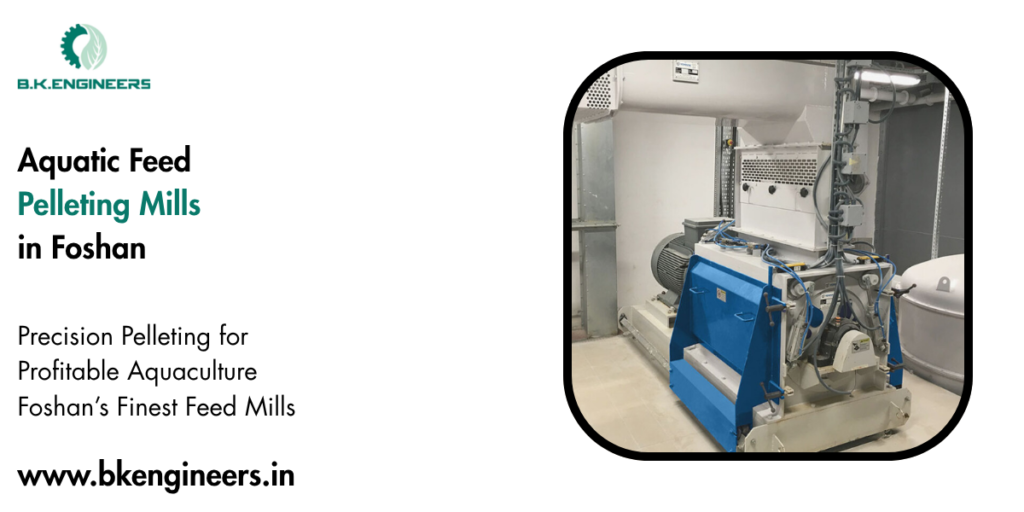
Aquatic Feed Pelleting Mills in Foshan
Introduction
At B.K. Engineers, we specialise in manufacturing a wide range of mills designed to meet your diverse needs. Our expertise spans across Cattle Feed Mills, Poultry Feed Mills, Aquatic Feed Mills, Bran Pelleting Mills, Hull Pelleting Mills, Grass Pelleting Mills, Alfalfa Pellets Mills, Wood Pellets Mills, and Straw Pelleting Mills. With our state-of-the-art technology and commitment to quality, we ensure that you get the best equipment for your production needs.
Aquatic Feed Pelleting Mills in Foshan are an essential part of the worldwide aquaculture business, which is expanding at a rate never seen before. Foshan, a well-known manufacturing powerhouse in China, has become a global centre for cutting-edge feed machinery, especially for the production of aquatic feed. This gives a chance for businesses like B.K. Engineers to provide top-notch pelleting solutions that satisfy global standards and provide economical and effective performance.
At B.K. Engineers, we understand the evolving needs of aquaculture businesses and deliver robust, high-performance pelleting solutions that align with international standards while maintaining affordability and reliability. The need for premium feed has never been higher in the rapidly expanding aquaculture sector. Growth rate, health, and profitability are all directly impacted by feed quality in fish farms and prawn farms. Here, Foshan’s Aquatic Feed Pelleting Mills have become well-known throughout the world for their cutting-edge engineering, effectiveness, and affordability. We are the best Aquatic Feed Pelleting Mills Manufacturer.
Understanding Aquatic Feed Pelleting Mills
- Aquatic feed pelleting mills are specialised machines designed to convert raw feed ingredients into compact, nutritionally balanced pellets for fish, shrimp, and other aquatic species. These pellets are engineered to maintain stability in water, ensuring minimal nutrient loss and maximum feed efficiency. We are the best Aquatic Feed Pelleting Mills Supplier.
- Hammer mills for fine grinding
- Conditioning systems for moisture and heat control
- Pellet mills for shaping feed
- Drying and cooling systems
- Automated control panels
- The pelleting process involves grinding, mixing, conditioning, and compressing feed materials through a die to form uniform pellets. This method enhances feed density, improves digestibility, and ensures consistent quality across batches.
Why Choose B.K. Engineers
1. Hub of Advanced Manufacturing & Technology
- Foshan is one of China’s major industrial hubs, known for high-end machinery production. Companies based here benefit from:
- Access to modern manufacturing facilities
- Integration of European and global technologies
- Continuous innovation in feed processing systems
2. High-Quality Pellet Production
- Aquatic feed pelleting mills are designed to produce uniform, nutrient-rich pellets that improve fish and shrimp growth.
- Uniform mixing ensures balanced nutrition
- Improved digestibility through heat and pressure processing
- Enhanced gelatinisation for better nutrient absorption
3. Better Feed Efficiency & Reduced Waste
- One of the biggest challenges in aquaculture is feed wastage. Foshan-based pelleting mills solve this by:
- Producing dense, water-stable pellets
- Reducing feed disintegration in water
- Minimising nutrient loss
4. Cost-Effective Investment with High ROI
- Foshan manufacturers are known for delivering competitive pricing without compromising quality.
- Lower initial investment compared to Western machines
- High production output
- Fast return on investment
5. Complete Feed Production Solutions
- Most Foshan-based suppliers provide end-to-end solutions, including:
- Grinding systems
- Mixing units
- Dryers and coolers
- Automation and control systems
6. Improved Fish Growth & Health
- Pelletized feed plays a direct role in aquaculture productivity:
- Balanced nutrition improves growth rate
- Reduced disease risk due to sterilisation during processing
- Better feed intake due to uniform pellet size
7. Strong Export Network & Global Trust
- Foshan-based manufacturers export worldwide, making them trusted by:
- Reliable quality standards
- Availability of spare parts
- Strong after-sales support
8. Easy Operation & Customisation
- Modern aquatic feed pelleting mills offer:
- User-friendly controls
- Adjustable pellet size and density
- Custom designs based on fish species
9. Environmentally Friendly Production
- Sustainability is a growing concern in aquaculture. Foshan pelleting mills support eco-friendly practices by:
- Utilizing agro-waste efficiently
- Reducing feed dust and pollution
- Improving water quality through stable pellets
10. Scalability for Growing Businesses
- Whether you are starting small or running a large commercial operation, these machines offer:
- Flexible capacity options
- Easy scalability
- Integration with automated systems
Applications of Aquatic Feed Pelleting Mills
1. Commercial Aquaculture Feed Production
- One of the primary applications of aquatic feed pelleting mills is in large-scale aquaculture farms and commercial feed production plants. These mills are used to manufacture feed for.
- Fish: tilapia, carp, salmon, catfish
- Shrimp and prawns
- Crabs and other crustaceans
2. Fish Feed Manufacturing Plants
- Aquatic feed pelleting mills are extensively used in dedicated fish feed factories to produce:
- Floating feed pellets
- Sinking feed pellets
- Slow-sinking feed
3. Integrated Feed Production Lines
- In modern feed processing plants in Foshan, pelleting mills are integrated into complete production lines that include:
- Grinding systems
- Mixing units
- Conditioning systems
- Pellet mills and cooling units
4. Nutritional Feed Enhancement Applications
- Pelleting mills are used to enhance the nutritional quality of aquatic feed by:
- Increasing gelatinisation of starch
- Improving digestibility
- Reducing feed wastage
5. Feed Processing for Diverse Aquatic Species
- These machines are designed to cater to a wide range of aquatic species, including:
- Freshwater fish
- Marine fish
- Ornamental fish
- Shellfish
6. Small, Medium & Large-Scale Operations
- Aquatic feed pelleting mills from Foshan are suitable for:
- Small aquaculture farms
- Medium-scale feed processing units
- Large industrial feed manufacturing plants
7. Cost Optimisation & Feed Efficiency
- Pelleting mills help reduce production costs by:
- Minimising feed loss
- Improving storage and transport efficiency
- Reducing dust and waste
8. Export-Oriented Feed Production
- Foshan-based aquatic feed pelleting mills are widely used in export-oriented feed plants due to:
- High-quality pellet output
- Compliance with international standards
- Advanced automation and durability
9. Sustainable Aquaculture Practices
- These machines contribute to sustainable aquaculture by.
- Reducing environmental pollution (less feed waste in water)
- Improving feed utilization
- Supporting eco-friendly farming practices
Table of Specifications Aquatic Feed Pelleting Mill
| Parameter | Specification |
|---|---|
| Material | Aquatic Feed Pelleting Mill |
| Production Capacity | 10–15 Ton/Hour |
| Main Motor Power | 132–160 kW |
| Feeder Power | 1.5 kW |
| Conditioner Power | 7.5 kW |
| Die Diameter | 508 mm |
| Pellet Size Range | 2–8 mm |
| Conditioner Type | Single / Double / Triple |
| Material | Stainless Steel Construction |
| Control System | PLC Automated |
| Drive Mechanism | Gear Drive |
| Application | Fish, Shrimp, Crab Feed |
Benefits of Aquatic Feed Pelleting Mills
1. High-Quality Feed Production
- One of the biggest advantages of aquatic feed pelleting mills is their ability to produce uniform, nutritionally balanced feed pellets. During the pelleting process, raw materials are finely ground, mixed, and compressed, ensuring every pellet contains consistent nutrients.
- Better fish growth
- Improved feed conversion ratio (FCR)
- Consistent feed quality across batches
2. Enhanced Digestibility & Nutrient Absorption
- Pelleting improves the digestibility of feed ingredients by breaking down complex compounds during processing. This makes it easier for aquatic species like fish and shrimp to absorb nutrients effectively.
- Faster growth rates
- Stronger immunity in aquatic animals
- Reduced feed wastage
3. Improved Water Stability
- Modern pelleting machines—especially those with advanced conditioning systems—produce pellets that are highly water-resistant.
- Pellets retain their shape in water for a longer time
- Reduced nutrient leaching
- Lower water pollution in fish ponds
4. Increased Production Efficiency
- Manufacturers in Foshan are known for integrating advanced automation and European technology into feed mills
- High production capacity
- Reduced manual labor
- Continuous and efficient operations
5. Cost-Effective Manufacturing
- Pelleting mills help reduce overall production costs by:
- Increasing feed density (more feed per unit volume)
- Minimising transportation and storage costs
- Reducing raw material wastage
6. Customisation & Versatility
- Aquatic feed pelleting mills can produce different types of feed, such as:
- Meet diverse aquaculture needs
- Customise pellet size, shape, and hardness
- Add nutrients like probiotics and enzymes
7. Better Feed Handling & Storage
- Pelletized feed is:
- Easier to transport
- Less prone to dust formation
- More stable during storage
8. Environmental Benefits
- High-quality pelleting reduces feed wastage and nutrient loss in water, which helps:
- Minimise water pollution
- Maintain pond ecosystem balance
- Support sustainable aquaculture practices
9. Integrated Turnkey Solutions
- Many Foshan-based manufacturers offer complete feed plant solutions, including:
- Grinding systems
- Mixing units
- Drying and coating systems
- Packaging units
10. Strong After-Sales Support & Innovation
- Foshan is a major industrial hub with continuous innovation in feed technology. Companies provide:
- Technical support
- Spare parts availability
- Process optimization services
Types of Aquatic Feed Pelleting Mills
1. Ring Die Pellet Mill
- This is the most widely used type for large-scale production. It offers high capacity and efficiency, making it ideal for industrial applications.
Features:
- Continuous operation
- High output
- Suitable for commercial feed plants
2. Flat Die Pellet Mill
- Flat die mills are suitable for small-scale or farm-level operations.
Features:
- Compact design
- Low investment cost
- Easy maintenance
3. Floating Feed Pellet Machine
- These machines produce pellets that float on water, ideal for fish feeding.
Features:
- Better feed monitoring
- Reduced wastage
- Suitable for surface-feeding fish
4. Sinking Feed Pellet Mill
- Designed to produce dense pellets that sink, commonly used for shrimp and bottom-feeding species.
Features:
- High-density pellets
- Strong water stability
- Ideal for aquaculture ponds
5. Twin-Screw Extruder Pellet Mill
- Advanced machines used for high-value feed production.
Features:
- High flexibility
- Better control over pellet texture
- Suitable for premium feed products
Conclusion
Aquatic feed pelleting mills are an essential component of modern aquaculture, ensuring efficient, cost-effective, and high-quality feed production. With its strong industrial base and technological advancements, Foshan stands out as a global leader in manufacturing these machines. We are the best Aquatic Feed Pelleting Mills Provider.
At B.K. Engineers, we are committed to delivering innovative and reliable feed processing solutions that empower aquaculture businesses to thrive. Whether you are setting up a new feed plant or upgrading existing systems, investing in advanced pelleting mills is a step toward sustainable and profitable aquaculture.