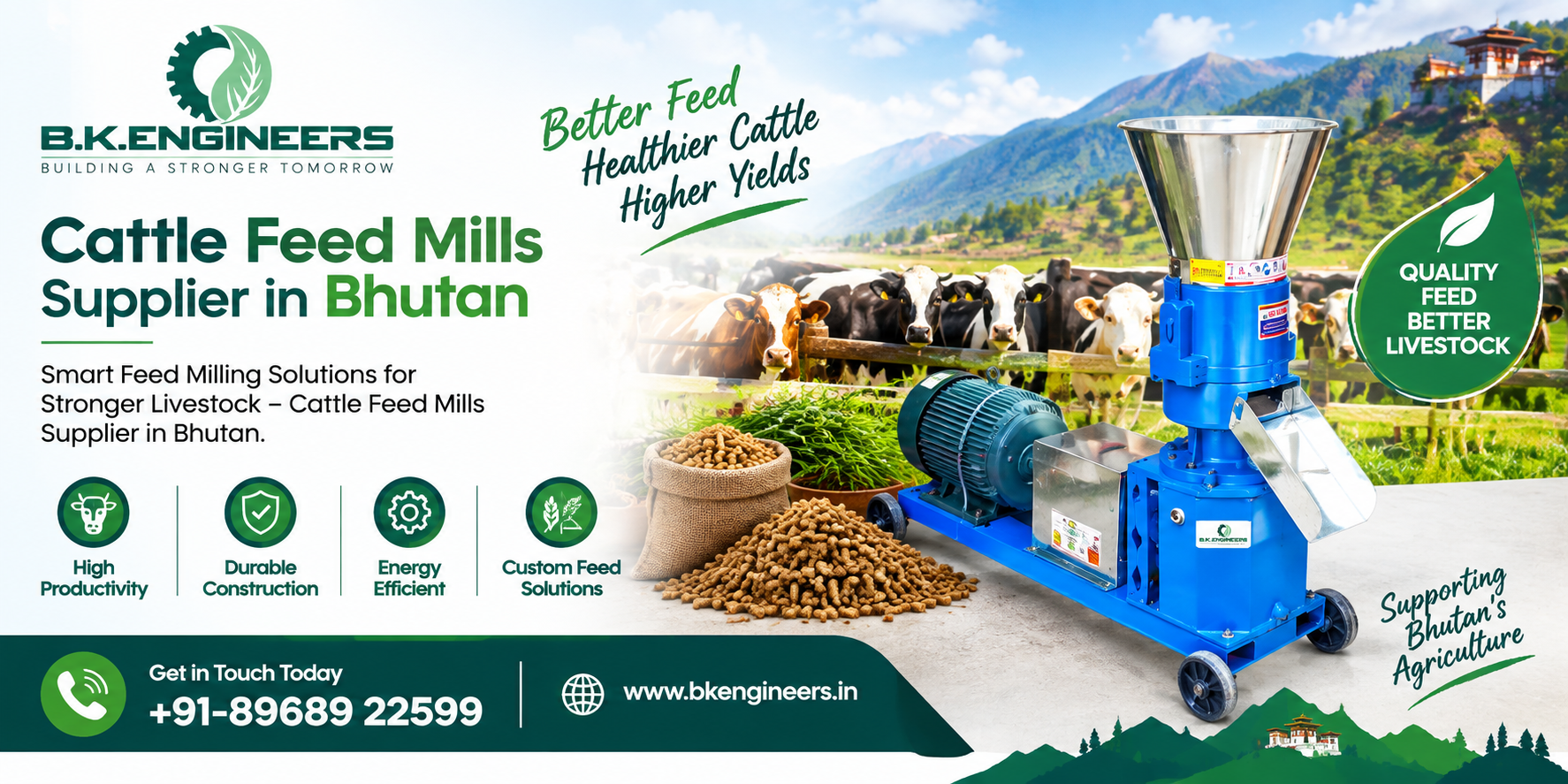
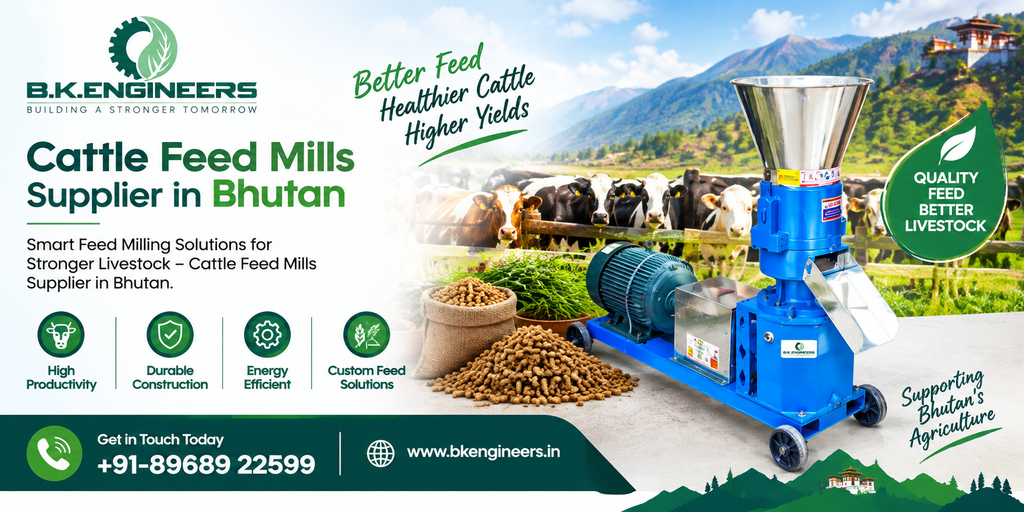
Cattle Feed Mills Supplier in Bhutan
Introduction
At B.K. Engineers, precision engineering is at the heart of everything we do, with your production goals guiding every decision. With over 56 years of experience and a strong commitment to quality, we work closely with you to build solutions that fit seamlessly into your operations. From complete feed mills to individual machines like hammer mills, mixers, and pellet mills, our technology supports cattle, poultry and aquatic feed production, optimizing every stage of your line.
The demand for quality cattle feed is increasing as dairy farming and livestock businesses focus on better animal nutrition, productivity, and feed management. A reliable Cattle Feed Mills Supplier in Bhutan can help farmers, dairy farms, feed producers, and agricultural businesses establish efficient feed processing systems. Modern cattle feed mills are designed to process different raw materials into balanced, easy-to-handle feed for cattle and other livestock. We are the best Cattle Feed Mills Manufacturer.
B.K. Engineers provides reliable cattle feed mill solutions designed for efficient processing, consistent production, and practical operation. With a focus on robust machinery and customer-oriented solutions, B.K. Engineers supports businesses looking to improve their cattle feed manufacturing capabilities.
What Is a Cattle Feed Mill
A cattle feed mill is a machine or complete processing system used to manufacture feed for cattle and other livestock. It processes raw materials such as grains, maize, wheat, bran, oil cakes, minerals, vitamins, and other nutritional ingredients.
Depending on the required feed type, the raw materials can be cleaned, crushed, ground, mixed, and converted into a suitable feed form. Modern feed mill machinery makes it easier to produce uniform feed while maintaining better control over the production process.
Cattle Feed Mills Supplier in Bhutan
Bhutan’s livestock and dairy sectors require efficient agricultural solutions that can support farmers and commercial feed producers. A reliable Cattle Feed Mills Supplier in Bhutan can provide machinery according to production requirements, raw materials, available space, and desired feed output. We are the best Cattle Feed Mills Provider.
B.K. Engineers understands that every feed production business can have different requirements. Small farms may need compact systems, while commercial feed manufacturers may require higher-capacity machinery and integrated production lines. The company focuses on providing practical solutions that can help improve productivity while keeping operation and maintenance straightforward.
Applications of Cattle Feed Mills
1. Dairy Farm Feed Production
Cattle feed mills are widely used on dairy farms to prepare feed according to the nutritional requirements of animals. Ingredients such as maize, wheat, rice bran, soybean meal, mineral mixtures, and other feed materials can be processed and mixed to produce a consistent feed formulation. This helps dairy farmers maintain regular feeding practices.
2. Commercial Cattle Feed Manufacturing
Large feed manufacturers can use cattle feed mill machinery for continuous production. The equipment can support important operations such as grinding, mixing, batching, and pellet production. A dependable Cattle Feed Mills Supplier in Bhutan can help businesses select machinery according to their production capacity and type of feed required.
3. Feed Pellet Production
Feed mills are commonly used to manufacture compact feed pellets. Pellets make handling, transportation, and storage easier while providing a uniform mixture of ingredients. Pellet production is useful for commercial livestock farms and feed manufacturers that need consistent feed output.
4. Poultry and Livestock Feed Processing
Although primarily designed for cattle feed production, suitable feed-processing systems can also be used for different livestock-feed applications. Depending on the machine configuration, the same processing line may be adapted for poultry, goat, sheep, and other animal feed formulations.
5. Cooperative Dairy Farming
Dairy cooperatives can install feed mills to produce feed for multiple farmers in their network. Centralised feed production can help maintain consistent feed quality and simplify procurement of raw materials. This can be particularly useful for organised dairy communities and agricultural cooperatives.
6. Goat and Sheep Feed Production
Livestock farmers can use feed mill machinery to process ingredients into suitable feed mixtures for goats and sheep. Grinding and mixing equipment helps create a more uniform feed by distributing different ingredients throughout the final product.
7. Agricultural Waste Utilisation
Some feed mills can process suitable agricultural by-products and feed ingredients into usable animal-feed formulations. Materials such as bran, certain grains, and other approved feed ingredients can be incorporated according to the required formulation. Proper ingredient selection and quality control remain essential.
8. Mineral and Supplement Mixing
Feed mixers can be used to distribute vitamins, minerals, protein sources, and other approved supplements evenly throughout the feed. Uniform mixing is important because small quantities of supplements need to be distributed consistently in the finished feed.
9. Bulk Feed Production for Large Farms
Large dairy and livestock operations require substantial quantities of feed on a regular basis. Industrial feed mill systems can help these businesses produce larger quantities efficiently while maintaining consistent processing and mixing.
10. Feed Processing for Different Formulations
Different animals and growth stages have different nutritional requirements. A properly designed feed mill can support multiple formulations by processing and mixing different combinations of ingredients. This flexibility allows feed producers to manufacture products for dairy cattle, calves, buffaloes, goats, and other livestock.
11. Improved Feed Handling and Storage
Processed feed is generally easier to handle than loose individual ingredients. Pelleted or properly prepared feed can simplify loading, transportation, and storage when appropriate storage conditions are maintained. Feed mills therefore support not only production but also the overall feed-supply process.
Benefits of Using a Modern Cattle Feed Mill
1. Better Feed Production Efficiency
A modern cattle feed mill helps streamline different stages of feed preparation, including grinding, mixing, pelleting, and handling. Properly selected machinery can reduce manual work and make production more systematic. This allows feed manufacturers and livestock businesses to handle larger quantities while maintaining a consistent production process.
2. Consistent Feed Quality
Uniform feed quality is essential for maintaining a reliable feeding program. A well-designed cattle feed mill can help achieve better particle-size consistency and proper mixing of ingredients. Consistent processing ensures that nutrients and feed ingredients are distributed more evenly throughout the finished product.
3. Improved Feed Utilisation
Pelleted and properly processed cattle feed can be easier to handle and distribute. Good-quality feed processing can also help reduce ingredient separation and wastage during transportation and feeding. This makes the overall feeding process more efficient for farms and commercial livestock operations.
4. Higher Production Capacity
For growing livestock businesses, production capacity is an important consideration. A suitable cattle feed mill can be selected according to the required output, allowing businesses to increase production without relying entirely on manual processing. Suppliers can help buyers select equipment according to their expected feed volume and operational requirements.
5. Reduced Labour Requirements
Traditional feed preparation may require considerable manual labour for grinding, mixing, and handling ingredients. Automated or semi-automated cattle feed mill systems can reduce repetitive work and improve workflow. This can help businesses use their workforce more effectively while maintaining regular production.
6. Better Ingredient Mixing
Proper mixing is one of the most important stages in cattle feed production. A reliable feed mill system can provide more uniform blending of grains, minerals, protein sources, vitamins, and other feed ingredients. Better mixing helps produce a more consistent final feed product.
7. Reduced Material Wastage
Efficient machinery can help minimise losses during grinding, mixing, pelleting, and material handling. When ingredients are processed and transferred properly, businesses can reduce unnecessary material wastage. Over time, this can contribute to better production economics.
8. Flexible Feed Production
Different cattle farms and feed manufacturers may require different feed formulations. A suitable cattle feed mill can support the processing of various ingredients and feed formulations, depending on the machinery configuration. This flexibility is useful for businesses serving different livestock requirements.
9. Easier Storage and Handling
Processed and pelleted feed is generally easier to store, transport, measure, and distribute than loose mixtures. Proper feed processing can help businesses organise their inventory and improve material handling throughout the production facility.
10. Technical Support and Guidance
Working with an experienced Cattle Feed Mills Supplier in Bhutan can provide more than just machinery. A professional supplier can assist with equipment selection, plant configuration, installation guidance, operation, and maintenance requirements. This support can be especially valuable for businesses setting up a new cattle feed production facility.
11. Long-Term Cost Efficiency
Although establishing a cattle feed mill requires an initial investment, efficient machinery can help reduce labour requirements, minimise wastage, improve production consistency, and increase output. These factors can contribute to better long-term operating efficiency and return on investment.
Why Choose B.K. Engineers
1. Quality Feed Mill Machinery
A professional Cattle Feed Mills Supplier in Bhutan provides reliable machinery designed for different stages of feed production, including grinding, mixing, pelleting, conveying, and packing. Good-quality equipment helps maintain consistent production and reduces unnecessary machine downtime.
2. Solutions for Different Production Capacities
Every cattle feed business has different production needs. A small farm may require a compact feed mill, while a commercial feed plant may need a larger and more automated system. An experienced supplier can recommend machinery according to production capacity, feed formulation, available space, and future expansion plans.
3. Consistent Feed Mixing
Uniform mixing is essential for producing balanced cattle feed. A properly selected feed mixer helps distribute ingredients evenly so that each batch has a consistent composition. This can support better feed quality and efficient use of ingredients.
4. Efficient Grinding System
Raw materials such as maize, grains, bran, and other feed ingredients may require size reduction before further processing. Reliable grinding equipment can help achieve the required particle size while supporting smooth downstream operations. Choosing the right grinder according to the raw material is therefore important.
5. Better Feed Pellet Production
For businesses producing pelleted cattle feed, a suitable pellet mill is an important part of the production line. Proper pellet formation can make feed easier to handle, store, transport, and distribute. A dependable supplier can help select a pelletizing system based on the required output and feed material.
6. Energy-Efficient Operation
Energy consumption is an important consideration for any feed manufacturing business. Modern feed mill machinery can be selected with operational efficiency in mind. A supplier with technical experience can help customers choose equipment that balances production capacity, performance, maintenance requirements, and energy use.
7. Customised Feed Mill Solutions
Not every cattle feed plant can use the same machinery configuration. A good Cattle Feed Mills Supplier in Bhutan can provide customised solutions based on plant layout, production targets, raw materials, automation requirements, and budget. Customised planning can also make better use of the available installation area.
8. Reliable Technical Support
Technical assistance is valuable before and after purchasing machinery. From machine selection and installation guidance to operating instructions and troubleshooting, professional support can help customers use their feed mill equipment more effectively.
9. Spare Parts Availability
Regular maintenance is necessary to keep feed mill machinery operating smoothly. Choosing a supplier that can support replacement parts, wear components, and maintenance requirements can help reduce unexpected production interruptions and extend equipment service life.
10. Improved Production Efficiency
A properly designed cattle feed mill can streamline several production stages. Grinding, mixing, pelleting, conveying, cooling, and packing can be organised into an efficient workflow. This can reduce manual handling and improve overall production management.
Types of Cattle Feed Mills
1. Small-Scale Cattle Feed Mill
A small-scale cattle feed mill is suitable for individual farmers, small dairy farms, livestock groups, and local feed producers. It normally includes basic equipment such as a grinder or hammer mill, feed mixer, small pellet machine, and simple conveying or packing arrangements.
This type of mill requires comparatively less space and investment. It can be useful when feed is produced mainly for the owner’s cattle rather than for large commercial distribution. Small-scale systems can process ingredients such as maize, wheat bran, oil cakes, hay, grass, and other suitable feed materials. The exact machine selection should be based on the formulation and desired output.
2. Medium-Scale Cattle Feed Mill
A medium-scale cattle feed mill is designed for growing dairy farms, cooperatives, and commercial feed businesses. It provides higher production capacity than a basic farm-level system and can include separate grinding, mixing, pelleting, cooling, screening, and storage sections.
A typical system may use a hammer mill for particle-size reduction, a horizontal or vertical mixer for uniform blending, and a pellet mill for producing compact feed pellets. Conveyors and elevators can then move materials between different processing stages.
3. Large-Scale Cattle Feed Mill
A large-scale cattle feed mill is developed for commercial manufacturers supplying feed to multiple farms, distributors, dealers, and livestock operations.
Such plants can include automated raw-material handling, cleaning, grinding, computerised batching, mixing, conditioning, pelletizing, cooling, screening, storage, and automatic packaging. Larger production lines can be configured in different capacities depending on the manufacturer’s requirements.
4. Mash Feed Mill
A mash feed mill produces finely ground and uniformly mixed feed without the pelletizing stage. It is comparatively simple because the feed does not need to pass through a pellet mill.
The basic process generally includes raw-material cleaning, grinding, weighing, mixing, ingredient dosing, storage, and bagging. Mash feed systems can be suitable for smaller manufacturers, farms, and local livestock operations. A major advantage is the simpler process and potentially lower initial equipment requirement compared with a complete pellet production line.
5. Cattle Feed Pellet Mill
A cattle feed pellet mill converts prepared feed material into compact pellets. It is one of the most important machines in a pellet-based cattle feed plant.
The process normally involves grinding and mixing the ingredients before the prepared material is compressed through a die. Depending on the equipment and formulation, different pellet diameters can be produced. Commercial cattle feed systems commonly offer pellet sizes suitable for different cattle groups.
Conclusion
A dependable cattle feed mill can become an important part of an efficient livestock feed production operation. From grinding and mixing to pelleting, cooling, screening, conveying, and packing, the right machinery can help streamline production and improve consistency. We are the best Cattle Feed Mills Provider in Punjab.
B.K. Engineers provides useful feed processing machinery solutions tailored to various production needs for companies looking for a Cattle Feed Mills Supplier in Bhutan. B.K. Engineers may be an important machinery partner for dairy farms, livestock companies, commercial feed makers, and agricultural organisations with dependable engineering, long-lasting equipment, and an emphasis on effective operation.