Cattle Feed Pelleting Mills in Andhra Pradesh
Introduction
At B.K. Engineers, we specialise in manufacturing a wide range of mills designed to meet your diverse needs. Our expertise spans across Cattle Feed Mills, Poultry Feed Mills, Aquatic Feed Mills, Bran Pelleting Mills, Hull Pelleting Mills, Grass Pelleting Mills, Alfalfa Pellets Mills, Wood Pellets Mills, and Straw Pelleting Mills. With our state-of-the-art technology and commitment to quality, we ensure that you get the best equipment for your production needs.
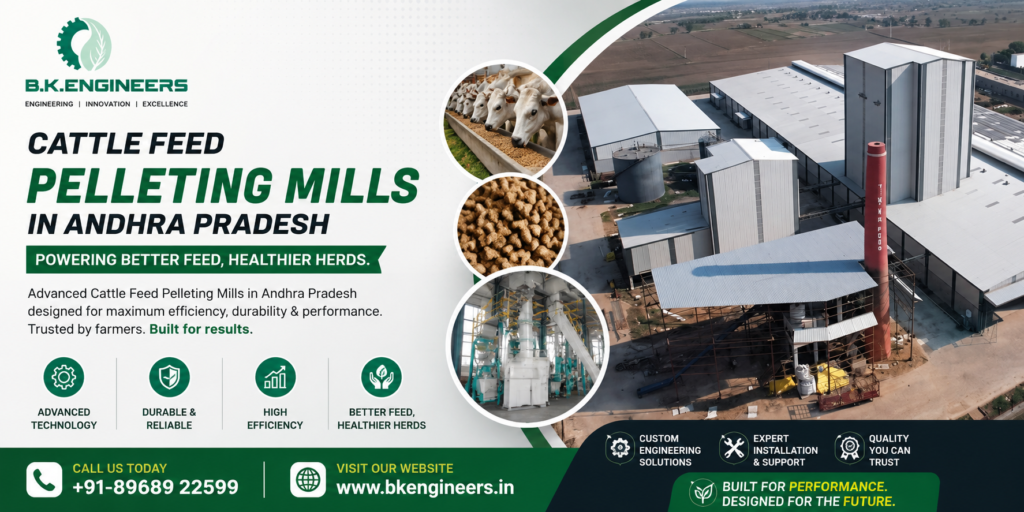
The dairy and livestock farming industry plays a major role in the agricultural economy of Andhra Pradesh. With the increasing demand for milk production and better-quality animal nutrition, farmers and manufacturers are focusing on modern processing technologies. One of the most effective solutions for producing high-quality animal feed is the use of Cattle Pelleting Mills in Andhra Pradesh. Cattle pelleting mills help convert raw materials such as maize, soybean meal, wheat bran, rice bran, oil cakes, and other nutritional ingredients into compact and easily digestible pellets. We are the best Cattle Feed Pelleting Mills Manufacturer.
These machines improve quality, reduce wastage, and provide balanced nutrition to cattle. Among the leading manufacturers, B.K. Engineers provide reliable and efficient cattle pelleting solutions designed to meet the requirements of modern dairy farms and manufacturing industries. With advanced engineering, durable construction, and customer-focused solutions, B.K. Engineers has become a trusted name in the cattle feed processing sector.
What is a Cattle Feed Pelleting Mill
- A Cattle Feed Pelleting Mill is a machine that converts powdered ingredients into compact pellets by applying pressure and heat. These pellets are easier for cattle to consume and digest compared to loose feed. The machine compresses mixed materials through specially designed dies, creating pellets of uniform size and density. These pellets contain balanced nutrition, reduce wastage, and improve storage and transportation. We are the best Cattle Feed Pelleting Mills Supplier.
- Dairy farms
- Animal feed manufacturers
- Poultry and livestock industries
- Agricultural cooperatives
- Commercial cattle feed production units
- Pelleted cattle offers several advantages compared to traditional loose It provides better nutrient distribution, improves digestion, reduces storage problems, and makes transportation easier. The main purpose of a cattle pellet mill is to improve feed quality, increase nutritional value, and make handling and storage easier.
Why Choose B.K. Engineers
Advanced Technology for High-Quality Feed Production
One of the major reasons to choose Cattle Pelleting Mills in Andhra Pradesh is their advanced processing technology. These machines are designed to handle different raw materials such as maize, soybean meal, wheat bran, rice bran, and other agricultural by-products.
- High-performance pellet mills
- Automatic feeding systems
- Efficient conditioning units
- Cooling and screening systems
- User-friendly control panels
These features help maintain consistent pellet quality and improve production efficiency.
Improved Nutritional Value of Cattle Feed
A major advantage of using a Cattle Pelleting Mill in Andhra Pradesh is the improvement in nutritional availability. During the pelleting process, ingredients are evenly mixed, preventing animals from selectively eating only certain components.
- Better digestion and nutrient absorption
- Balanced protein and energy supply
- Reduced ingredient separation
- Improved animal growth and milk production
For dairy farmers in Andhra Pradesh, high-quality pelleted feed plays an important role in improving cattle performance and maintaining animal health.
Suitable for Andhra Pradesh’s Growing Dairy Industry
Andhra Pradesh has a strong agricultural base with a large number of dairy farms and livestock owners. The increasing demand for milk and dairy products has created a need for efficient cattle production systems.
- Dairy feed manufacturing plants
- Commercial livestock farms
- Cooperative dairy societies
- Agricultural businesses
- Animal nutrition companies
These mills help businesses produce large quantities of quality feed while maintaining profitability.
Higher Production Capacity and Efficiency
Traditional methods of cattle feed preparation often require more manual effort and produce inconsistent results. A modern Cattle Feed Pelleting Mill offers high production capacity with minimum labour requirements.
- Continuous feed production
- Faster processing speed
- Reduced manpower dependency
- Better resource utilization
- Consistent pellet size and quality
For industries looking to expand their feed production capacity, investing in a reliable pelleting mill is a smart long-term decision.
Better Feed Storage and Transportation
Pelleted cattle feed has several advantages when it comes to storage and logistics. Unlike powdered or loose feed, pellets have better density and durability.
- Less dust formation
- Reduced spoilage
- Easy packaging
- Longer storage life
- Convenient transportation
This makes pelleted feed a preferred option for large-scale cattle feed suppliers and distributors.
Designed for Different Feed Requirements
Every livestock farm has different nutritional requirements. Advanced Cattle Feed Pelleting Mills in Andhra Pradesh can be customised according to production needs, feed formulations, and output capacity.
- Animal age and category
- Dairy production requirements
- Raw material availability
- Regional farming conditions
This flexibility allows businesses to manufacture specialised feed products for different markets.
Environment-Friendly Feed Processing
Modern pelleting mills also contribute to sustainable feed production. Efficient processing reduces material wastage and improves resource utilisation.
Benefits include:
- Lower dust generation
- Better utilisation of agricultural by-products
- Reduced transportation costs
- Efficient energy usage
Higher Production Capacity for Growing Feed Demand
Andhra Pradesh has a strong agricultural and dairy sector, creating a continuous demand for commercial cattle feed. Cattle Feed Pelleting Mills in Andhra Pradesh are designed to meet this increasing requirement by offering high production capacity and reliable performance.
- Increase production efficiency
- Reduce manual labour dependency
- Meet market demand quickly
- Improve profitability
Reduction in Feed Wastage
Traditional cattle feed often results in wastage due to uneven mixing and poor handling. Pelletized feed minimises these problems by creating compact and stable feed particles.
- Are easier to transport
- Have a longer storage life
- Produce less dust
- Reduce ingredient separation
- Minimise feed loss
Applications of Cattle Feed Pelleting Mills
1. Dairy Farm Feed Production
One of the major applications of cattle feed pelleting mills is supplying balanced feed for dairy farms. These mills help manufacture pellets containing essential proteins, carbohydrates, minerals, and vitamins required for healthy cattle growth and improved milk production.
- Better nutrient availability
- Reduced feed wastage
- Improved digestion
- Consistent feeding quality
Large dairy farms in Andhra Pradesh use pellet feed to maintain uniform nutrition for cows and buffaloes throughout different growth stages.
2. Commercial Cattle Feed Manufacturing
Cattle Feed Pelleting Mills are widely used by commercial feed manufacturers to produce large quantities of animal feed for farmers and livestock owners. The pelletizing process helps manufacturers create standardized feed products with accurate ingredient mixing and better shelf life.
- Bulk feed production
- Automatic processing
- Efficient raw material utilization
- Quality-controlled feed manufacturing
Animal feed regulations in Andhra Pradesh also recognize pelleted feed as part of compounded and balanced animal feed production.
3. Livestock Farming Applications
Cattle Feed Pelleting Mills are beneficial for different livestock farming operations, including:
- Dairy cattle farms
- Buffalo farms
- Calf rearing units
- Goat and sheep farms
- Integrated livestock farms
The produced pellets provide a complete nutritional solution that supports animal growth, reproduction, and overall health.
4. Agricultural Waste Utilization
Andhra Pradesh produces various agricultural residues such as rice husk, maize waste, straw, and oilseed by-products. Cattle Feed Pelleting Mills help convert these materials into valuable animal feed products.
Benefits include:
- Effective waste management
- Additional income opportunities for farmers
- Sustainable feed production
- Reduced dependency on traditional fodder sources
5. Feed Export and Distribution Businesses
Modern cattle feed pellet plants are also used by feed distributors and exporters who supply animal feed products to different regions. Pellet form makes transportation easier because pellets are compact, durable, and have better storage properties compared with loose feed.
These mills help businesses achieve:
- High production capacity
- Easy packaging
- Long-distance transportation
- Consistent product quality
6. Veterinary and Nutrition-Based Feed Manufacturing
Many cattle feed manufacturers use pelleting mills to produce specialized feeds according to animal requirements, such as:
- High-protein cattle feed
- Mineral-enriched feed
- Calf starter feed
- Lactation feed
- Maintenance feed
Controlled formulation helps farmers provide targeted nutrition for better livestock performance.
7. Large Dairy Cooperative Operations
Dairy cooperatives and large farming groups use cattle feed pelleting mills to manufacture feed at centralized facilities. Automated systems help maintain quality standards while reducing production costs.
Key advantages include:
- Continuous production
- Better inventory management
- Reduced manual labour
- Uniform pellet size and quality
8. Improved Storage and Transportation
Loose feed materials often create handling and storage challenges. Pelleting mills compress feed ingredients into dense pellets, reducing volume and improving durability.
- Less dust formation
- Easy handling
- Reduced storage space
- Lower transportation losses
9. Customised Feed Pellet Manufacturing
Modern cattle feed pelleting mills allow manufacturers to produce customized feed according to animal age, breed, and production requirements.
- High-protein cattle feed pellets
- Milk production enhancer feed
- Calf growth pellets
- Maintenance feed pellets
- Special nutritional feed blends
10. Cost Reduction in Feed Production
Pelleting technology reduces feed wastage and improves production efficiency. Since pellets have better density and handling properties, manufacturers can achieve economical production while maintaining quality standards.
- Lower transportation cost
- Reduced ingredient wastage
- Better feed conversion ratio
- Efficient production process
Benefits of Cattle Feed Pelleting Mills
1. Improved Nutritional Value of Animal Feed
One of the biggest benefits of a Cattle Feed Pelleting Mill in Andhra Pradesh is the production of nutritionally balanced feed. The pelleting process ensures that all ingredients are mixed properly, allowing every pellet to contain the required amount of protein, minerals, vitamins, and energy.
- Milk production
- Animal growth
- Reproductive performance
- Overall cattle health
A well-formulated pellet feed supports better digestion and provides animals with essential nutrients in a controlled manner.
2. Better Feed Digestibility
Pelleting improves the physical structure of cattle feed by compressing fine ingredients into uniform pellets. During the manufacturing process, heat and pressure help break down certain feed components, making nutrients easier for animals to absorb.
- Improved nutrient utilization
- Better feed conversion ratio
- Reduced digestive problems
- Increased animal performance
This makes cattle feed pelleting mills highly beneficial for dairy farmers who require efficient feed solutions.
3. Reduction in Feed Wastage
Traditional loose feed often creates problems such as dust formation, ingredient separation, and feed loss during transportation and feeding.
- Pellets have uniform size and shape
- Animals consume more complete feed portions
- Fine particles are minimized
- Storage losses are reduced
This helps farmers save money and improves overall feed management efficiency.
4. Easy Storage and Transportation
Pelleted cattle feed has a higher density compared to loose feed, making it easier to store and transport.
- Requires less storage space
- Longer shelf life
- Easy packaging
- Convenient handling
For commercial cattle feed manufacturers in Andhra Pradesh, pellet mills provide an efficient way to produce and supply feed in bulk quantities.
5. Increased Milk Production
Quality nutrition directly affects dairy performance. Cattle feed produced through pelleting mills provides a consistent supply of essential nutrients required for milk-producing animals.
- Higher milk yield
- Better milk quality
- Improved animal energy levels
- Healthy body condition
This is especially valuable in dairy-focused regions where farmers depend on consistent milk production.
6. Uniform Feed Quality
A major challenge in animal feed production is maintaining consistency. A Cattle Feed Pelleting Mill ensures every batch maintains similar quality standards.
- Accurate ingredient mixing
- Consistent pellet size
- Controlled formulation
- Improved quality assurance
Manufacturers can produce customised feed formulas according to cattle age, breed, and production requirements.
7. Cost-Effective Feed Production
Although installing a cattle feed pelleting mill requires investment, it provides long-term economic benefits.
- Reduced raw material losses
- Lower transportation expenses
- Better production efficiency
- Higher production capacity
Types of Cattle Feed Pelleting Mills
1. Flat Die Cattle Feed Pellet Mills
Flat die pellet mills are commonly used for small-scale cattle feed production. These machines are compact, easy to operate, and require less maintenance.
Features:
- Simple operating system
- Low investment cost
- Suitable for small farms
- Easy maintenance
- Compact design
2. Ring Die Cattle Feed Pellet Mills
Ring die pellet mills are designed for large-scale commercial feed production. They offer higher production capacity and excellent pellet quality.
Features:
- High production output
- Continuous operation
- Uniform pellet size
- Energy-efficient performance
- Suitable for industrial feed plants
3. Electric Cattle Feed Pellet Mills
Electric pellet mills use electric motors to operate the pelleting process. These machines are widely used because they provide stable performance and require less manual effort.
- Easy operation
- Low operating cost
- High efficiency
- Suitable for regular production
4. Diesel Operated Cattle Feed Pellet Mills
Diesel-operated pellet mills are useful in areas where electricity supply is limited. These machines provide flexibility and can operate in remote agricultural locations.
- Suitable for rural areas
- Independent operation
- Strong performance
- Easy mobility
5. Automatic Cattle Feed Pelleting Mills
Automatic cattle feed pellet mills use advanced automation technology to reduce human involvement and improve production accuracy.
- Automated feeding system
- Improved production control
- Reduced labour requirements
- Better consistency
- Higher productivity
Conclusion
High-quality cattle feed plays an essential role in improving livestock productivity and supporting the growth of the dairy industry. Investing in advanced Cattle Feed Pelleting Mills in Andhra Pradesh helps businesses manufacture nutritious, durable, and cost-effective feed pellets. We are the best Cattle Feed Pelleting Mills Provider.
B.K. Engineers provide reliable cattle feed pelleting solutions designed to meet the needs of small farms as well as large-scale feed manufacturing plants. With advanced technology, quality manufacturing, and customer-focused service, B.K. Engineers is a trusted partner for efficient cattle feed production.