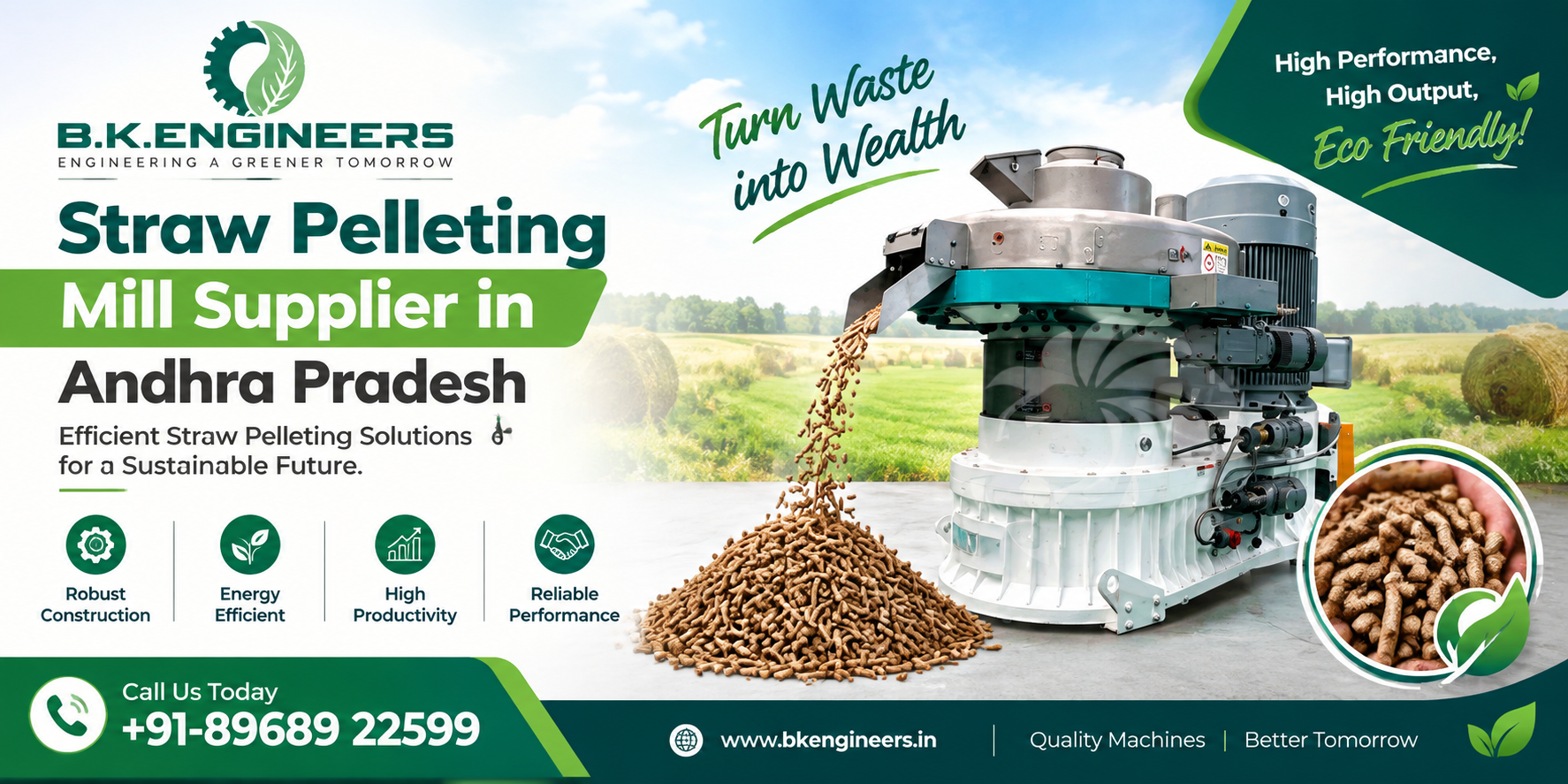
Straw Pelleting Mill Supplier in Andhra Pradesh
Introduction
At B.K. Engineers, precision engineering is at the heart of everything we do, with your production goals guiding every decision. With over 56 years of experience and a strong commitment to quality, we work closely with you to build solutions that fit seamlessly into your operations. From complete feed mills to individual machines like hammer mills, mixers, and pellet mills, our technology supports cattle, poultry and aquatic feed production, optimising every stage of your line.
Agricultural waste is available in large quantities across India, especially in farming states like Andhra Pradesh. Straw from rice, wheat, maize, and other crops can be converted into useful biomass fuel and animal feed products with the right processing equipment. A Straw Pelleting Mill Supplier in Andhra Pradesh helps industries and farmers turn loose straw into compact, easy-to-handle pellets.
Pelletizing is an efficient method of converting agricultural residues into uniform pellets. Straw pellets are easier to store, transport, and use compared with loose straw. They can be used for biomass boilers, heating applications, animal bedding, and other industrial purposes depending on the raw material and pellet quality. We are the best straw pellet mill manufacturer.
B.K. Engineers is a trusted manufacturer and supplier of pelleting machinery for different biomass and feed applications. The company provides reliable pellet mill solutions designed to support efficient processing and consistent production.
What Is a Straw Pelleting Mill
A straw pelleting mill is a machine used to compress processed straw into small cylindrical pellets. The straw is first cleaned and prepared before entering the pellet mill. Inside the machine, pressure and suitable processing conditions compact the material through a die to form pellets. We are the best straw pellet mill provider.
The final pellet size can depend on the die configuration, raw material, moisture level, and application requirements. A properly designed pelleting system can help improve material handling and make agricultural waste more useful. Industries looking for a Straw Pelleting Mill Supplier in Andhra Pradesh can choose equipment according to their production capacity, raw material type, and operating requirements.
Why Straw Pelletizing Is Important
Agricultural residues are available in large quantities across farming regions. Straw can be difficult to transport and store in its loose form because it takes up considerable space. Pelletizing solves this problem by increasing the density of the material.
- Compact and easy to handle
- Convenient for transportation
- Better storage efficiency
- Uniform pellet size
- Suitable for automated feeding systems
- Makes better use of agricultural residues
- Can be used as a biomass fuel
- Reduces the volume of loose straw
Pellets are easier to handle, transport, store, and use than loose straw. This makes straw pellet production useful for biomass fuel applications and other industries that require compact agricultural residue products. A reliable Straw Pelleting Mill Supplier in Andhra Pradesh can provide machinery according to production capacity, raw material characteristics, pellet size, and operating requirements.
Why Choose B.K. Engineers
1. Experience in Straw Pelletizing Technology
- An experienced Straw Pelleting Mill Supplier in Andhra Pradesh can understand the special characteristics of straw-based raw materials. Straw can vary in moisture, fibre length, density and composition depending on the crop and harvesting method. A suitable mill design helps prepare this material properly before pelletizing. Experienced suppliers can recommend appropriate machinery and process configurations according to the customer’s raw material, desired output and application.
2. Suitable Solutions for Agricultural Residues
- Straw is available in different forms, including paddy straw, wheat straw, maize stalks and other crop residues. The Ministry of Power’s model contract identifies several agricultural residues as suitable raw materials for biomass pellet manufacturing. A professional supplier can help select equipment based on the specific material available at the plant location. This is particularly useful for businesses operating close to agricultural areas where raw-material availability can change seasonally.
3. Efficient Size Reduction and Preparation
- Proper raw-material preparation is an important part of pellet production. Straw generally needs to be reduced to a suitable size before entering the pellet mill. Depending on the plant design, shredding, crushing, or other preparation equipment may be used. A well-planned system helps maintain a smoother material flow toward the pelletizing stage and can support more consistent pellet production.
4. Controlled Moisture Management
- Moisture has an important role in biomass pelletizing. Excess moisture can affect pellet formation, while material that is too dry may also create processing challenges. A reliable Straw Pelleting Mill Supplier in Andhra Pradesh can design the system with suitable drying and moisture-management equipment according to the characteristics of the raw material. Existing straw pellet plants in Andhra Pradesh commonly incorporate shredding, drying and pelletizing stages as part of the processing system.
5. Consistent Pellet Production
- One of the main reasons businesses invest in a straw pelleting mill is to convert loose agricultural residues into more uniform pellets. Pellets can be easier to handle than loose straw because they occupy less space and can be transported through suitable handling systems. Consistent production also helps businesses maintain more predictable material quality for their intended applications.
6. Better Handling and Storage
- Loose straw can occupy considerable storage space and may be difficult to handle efficiently. Pelletizing changes the physical form of the material into compact units. A complete pelleting system can therefore include equipment for pellet cooling, screening, conveying and storage. These systems help move the finished pellets from production to packing or bulk storage in an organised manner.
7. Reliable Machinery for Continuous Operation
- A straw pelleting mill may operate for extended periods, making machine construction and component quality important considerations. Strong machinery, appropriate drives and properly selected wear components can contribute to dependable operation. A supplier should also provide clear information about maintenance requirements, replacement parts and operating procedures so that the plant can be managed effectively over the long term.
8. Reduced Agricultural Waste
- Pelletizing provides a productive route for utilising agricultural residues that might otherwise have limited economic value. In Andhra Pradesh, biomass businesses are sourcing agricultural residues such as maize stover, rice husk, cotton stalks and cashew shells for pellet production. Converting these materials into pellets can create a useful product from agricultural by-products while supporting better resource utilisation.
9. Easier Operation and Maintenance
- Pellet machinery operates under demanding conditions because agricultural residues can contain fibrous material and impurities. Regular maintenance is therefore important for dependable operation. A supplier that provides proper operating guidance, maintenance information, spare parts support and technical assistance can help plant operators maintain the equipment effectively.
10. Better Long-Term Plant Planning
- Choosing an experienced Straw Pelleting Mill Supplier in Andhra Pradesh can be valuable when planning for future expansion. A supplier can consider the possibility of increasing production capacity, adding additional raw materials or improving automation at a later stage. Instead of selecting machinery only for today’s requirements, businesses can discuss a scalable plant configuration that supports future production needs.
Applications of Straw Pelleting Mill
1. Biomass Fuel Production
- One of the major applications of a straw pelleting mill is the production of biomass fuel pellets. Straw can be converted into dense pellets that are convenient for use in suitable biomass boilers, furnaces, and heating systems. This allows agricultural residues to be transformed into a useful fuel resource instead of remaining as loose waste.
2. Industrial Boiler Fuel
- Straw pellets can be used as a biomass fuel in industrial heating applications where compatible pellet-burning systems are installed. Industries can use processed biomass pellets for heat generation and other thermal requirements, depending on the specifications of their boiler or combustion equipment.
3. Agricultural Waste Management
- Andhra Pradesh has substantial agricultural activity, creating different types of crop residues. A straw pelleting mill helps convert loose agricultural residues into a more manageable form. This can reduce the volume of material requiring storage and create a useful product from biomass waste.
4. Rice Straw Pellet Production
- Rice straw is an important raw material for pellet production. A properly designed Straw Pelleting Mill Supplier in Andhra Pradesh can provide equipment for processing rice straw into uniform pellets. The overall process may include shredding, moisture control, drying, and pelletizing to achieve the required pellet characteristics.
5. Animal Bedding
- Straw pellets can also have applications as animal bedding material. Their compact form makes handling, transportation, and storage easier than loose straw. Depending on pellet quality and end-use requirements, they can be processed for livestock-related bedding applications.
6. Composting Applications
- Pelletized agricultural residues can also be utilised in composting applications. Processing straw into pellets provides a convenient and controlled form of biomass that can be incorporated into suitable composting operations. Rice straw pellet plants are documented for applications including composting.
7. Biomass Pellet Plants
- A straw pelleting mill can form an important part of a complete biomass pellet plant. Depending on the raw material and production requirements, the system can include material handling, size reduction, drying, pelletizing, cooling, screening, and packing equipment. This enables businesses to establish an organised biomass pellet production process.
8. Renewable Energy Projects
- Straw pellets can support renewable-energy initiatives by converting agricultural residues into a usable biomass fuel. This creates an opportunity to utilise locally available biomass resources and reduce dependence on conventional fossil-based fuels in applications where biomass pellets are technically suitable.
9. Pellet Storage and Transportation
- Loose straw requires considerable storage space and can be difficult to transport efficiently. Pelletizing compresses the material into a denser form, making the finished product easier to handle, bag, stack, and transport. This is particularly useful for businesses supplying biomass pellets to customers in different locations.
10. Commercial Biomass Pellet Supply
- Businesses can establish commercial pellet production facilities using straw as a primary raw material. The finished pellets can be supplied to suitable industrial, commercial, agricultural, or energy-related users according to their quality and application requirements.
Benefits of a Straw Pelleting Mill
1. Efficient Utilisation of Agricultural Waste
- One of the major benefits of a straw pelleting mill is the effective utilisation of agricultural residues. Instead of leaving straw in fields or treating it as low-value waste, the material can be processed into useful pellets. This creates a practical route for converting crop residues into a value-added product.
2. Compact and Easy-to-Handle Pellets
- Loose straw takes up considerable storage and transportation space. A pelleting mill compresses prepared straw into dense pellets, making handling, stacking, loading, and transportation easier. The compact form can also make storage management more convenient for biomass businesses.
3. Suitable for Biofuel Production
- Straw pellets can be used as biomass fuel in suitable boilers, furnaces, and industrial heating systems. Their standardised form makes them easier to feed into compatible combustion equipment. Government initiatives in India have also recognised pelletisation as one route for utilising agricultural residues and increasing the availability of biomass pellets.
4. Supports Renewable Energy
- Straw is a biomass resource generated from agricultural activity. Converting it into pellets provides an alternative source of solid biomass fuel. This can support industries looking to incorporate biomass into their energy mix, depending on their equipment and fuel requirements.
5. Reduces Agricultural Residue Waste
- A straw pelleting mill gives agricultural residues an organised utilisation pathway. Instead of allowing usable biomass to remain unmanaged, the material can be collected, processed, and converted into pellets. Such utilisation is also connected with India’s broader efforts to manage crop residues and reduce open-field residue burning.
6. Creates Value from Low-Value Biomass
- Agricultural residues can have limited value when they are available in loose form. Pelletisation adds processing value by converting straw into a standardised product that can be supplied to biomass fuel users and other suitable markets. This can create additional commercial opportunities for entrepreneurs involved in biomass collection and processing.
7. Consistent Pellet Production
- A properly designed pelleting system can provide controlled processing of prepared biomass. Depending on the raw material, moisture content, preparation, machine configuration, and operating conditions, the mill can produce pellets with relatively consistent dimensions and density.
8. Multiple Raw Material Options
- Straw pelleting equipment can be suitable for different biomass materials when the machinery is correctly selected for the feedstock. Depending on the system, materials may include rice straw, wheat straw, maize residue, grass, and other agricultural biomass. This flexibility can help businesses work with locally available raw materials.
9. Useful for Different Industries
- Straw pellets can have several potential applications. They may be used as biomass fuel and, where specifications are appropriate, for applications such as animal bedding or compost-related uses. Existing pellet plants in Andhra Pradesh demonstrate the use of rice straw for biofuel, bedding, and compost applications.
10. Supports Rural Business Opportunities
- A straw pelleting operation can create demand for activities such as biomass collection, transportation, sorting, processing, storage, pellet production, packaging, and distribution. This can support local employment and create business opportunities around agricultural residue management.
11. Better Storage Management
- Loose straw can be difficult to store efficiently because of its large volume. Pellets are much more compact and can be stacked systematically when stored under appropriate conditions. Proper moisture control and suitable storage practices remain important for maintaining pellet quality.
Types of Straw Pelleting Mills
1. Flat Die Straw Pellet Mill
- A flat die pellet mill is a compact machine commonly used for smaller-scale pellet production. It has a relatively simple design and can be suitable for farms, small businesses, and trial production. Its compact structure can make installation and maintenance easier. It may be considered where production requirements are moderate.
2. Ring Die Straw Pellet Mill
- Ring die pellet mills are designed for larger-scale and continuous pellet production. The ring-shaped die allows the machine to process substantial quantities of prepared biomass. These machines are commonly considered for commercial pellet plants where higher production capacity is required.
3. Biomass Pellet Mill
- A biomass pellet mill is designed to process different types of biomass materials. Depending on the machine configuration, materials may include straw, crop residues, sawdust, husk, and other suitable biomass. This type of machine can provide flexibility for businesses that process more than one raw material.
4. Small Straw Pellet Mill
- A small straw pellet mill is useful for users who do not require a large industrial production line. It can be suitable for small agricultural operations, demonstration plants, and businesses entering the biomass pellet industry. Its smaller footprint can also help when available installation space is limited.
5. Industrial Straw Pellet Mill
- Industrial straw pellet mills are designed for high-volume production. They can be integrated with equipment such as hammer mills, dryers, conveyors, coolers, screens, and packing systems. These machines are suitable for businesses planning commercial-scale biomass pellet production.
How to Select the Right Straw Pellet Mill
Before purchasing a pellet mill, customers should evaluate several important factors. First, identify the type and condition of the straw. Different straw materials may have different moisture levels, fibre characteristics, and preparation requirements.
Second, determine the required production capacity. A small farm operation may need a different machine from a commercial biomass plant. Third, consider the desired pellet diameter and final application. The die configuration should be selected according to the required pellet specifications.
Conclusion
Agricultural straw can be converted from a low-density residue into a useful and manageable pelletised product with the right machinery. A properly designed straw pellet production system can make handling, storage, transportation, and utilisation more convenient. We are the best Straw Pelleting Mill Provider in Punjab.
Choosing the right equipment is important for achieving consistent production and efficient operation. B.K. Engineers offers pelleting machinery and biomass processing solutions designed for different materials and production requirements.
If you are looking for a Straw Pelleting Mill Supplier in Andhra Pradesh, B.K. Engineers can help you select a suitable pelleting solution based on your raw material, capacity, and application requirements. The company serves customers across India and can provide machinery solutions according to project needs.