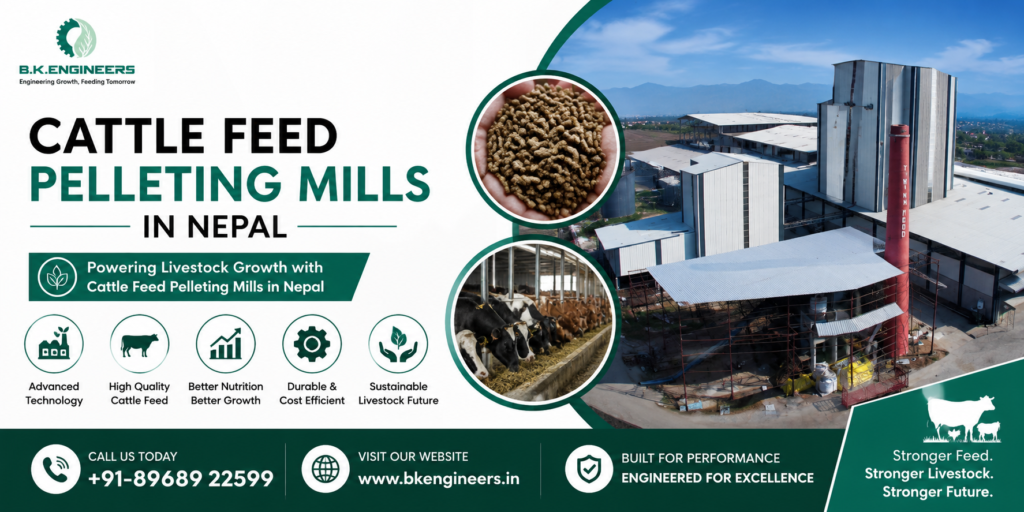
Cattle Feed Pelleting Mills in Nepal
Introduction
At B.K. Engineers, we specialise in manufacturing a wide range of mills designed to meet your diverse needs. Our expertise spans across Cattle Feed Mills, Poultry Feed Mills, Aquatic Feed Mills, Bran Pelleting Mills, Hull Pelleting Mills, Grass Pelleting Mills, Alfalfa Pellets Mills, Wood Pellets Mills, and Straw Pelleting Mills. With our state-of-the-art technology and commitment to quality, we ensure that you get the best equipment for your production needs.
Agriculture and animal production are crucial to Nepal’s economy. Cattle, buffalo, goats, and poultry are the main sources of income for many farmers. High-quality feed is crucial for enhancing animal health and milk production. This is where Nepalese cattle feed pelleting mills come in handy. Grain, corn, soybean, rice bran, and other raw materials can be turned into small, compact pellets with the use of a cow feed pelleting mill.
Compared to loose feed, these pellets are more nutritious and easier for animals to digest. B.K. Engineers is a reputable brand in the production of high-performance feed equipment, such as cattle feed pelleting mills made for durability, efficiency, and contemporary farming requirements. We are the best Cattle Feed Pelleting Mills Manufacturer.
What is a Cattle Feed Pelleting Mill
- A cattle feed pelleting mill is a machine or complete system used to convert raw animal feed ingredients into pellet form. These pellets are small, cylindrical, and compressed feed pieces that are easier for animals to eat and digest. We are the best Cattle Feed Pelleting Mills Supplier.
- Crushing raw materials
- Mixing ingredients
- Conditioning with steam or moisture
- Compressing into pellets
- Cooling and packaging
- These pellets are uniform in size and contain balanced nutrition, which improves animal health and productivity. In Nepal, demand for such machines is increasing due to modern farming practices and growing dairy industries.
Why Choose B.K. Engineers
1. Improved Feed Quality and Nutrition
- One of the biggest advantages of cattle feed pelleting mills is the consistency and quality of feed they produce. Pelleted feed is made by compressing raw ingredients such as maize, wheat bran, soybean meal, minerals, and vitamins into uniform pellets.
- Balanced nutrition in every bite
- Reduced selective eating by cattle
- Better digestion and nutrient absorption
- Elimination of harmful bacteria due to heat during pelleting
2. Increase in Milk Production and Growth Rate
- Pellet feed is scientifically proven to enhance milk production in dairy cattle. The compact form of feed allows animals to consume a balanced diet efficiently, which leads to:
- Higher milk yield in cows and buffaloes
- Faster weight gain in beef cattle
- Improved reproductive health
3. Reduced Feed Wastage
- Traditional loose feed often results in wastage due to sorting and spillage. Pellet feed eliminates this issue.
- Minimal feed loss during feeding
- No selective eating of ingredients
- Easier storage and transportation
- Longer shelf life compared to raw feed mixtures
4. Cost Efficiency for Farmers
- Although setting up a cattle feed pelleting mill requires initial investment, it significantly reduces long-term costs.
- Lower feed consumption per unit of milk produced
- Bulk production reduces ingredient cost
- Less dependency on imported ready-made feed
- Reduced labor costs in feed preparation
5. Better Digestibility and Animal Health
- Pelleted feed is easier for cattle to digest compared to loose feed. The steam-conditioning and heat treatment during pelleting improve starch gelatinization and protein availability.
- Reduced digestive disorders
- Improved gut health
- Stronger immunity
- Lower veterinary costs
6. Adaptability to Local Raw Materials
- Nepal has rich agricultural resources like maize, rice bran, mustard cake, and wheat by-products. Cattle feed pelleting mills can easily process these local ingredients into high-quality feed.
- Utilizing locally available raw materials
- Supporting local farmers and agriculture economy
- Reducing dependency on imported feed ingredients
- Encouraging sustainable farming practices
7. Easy Storage and Transportation
- Pellet feed is compact, dry, and durable. It does not spoil easily and can be stored for a longer time without losing nutritional value.
- Space-saving storage
- Easy transport across remote areas
- Resistant to moisture damage
- Reduced contamination risk
8. Growing Demand in Nepal’s Dairy Industry
- The dairy sector in Nepal is growing rapidly due to increasing milk demand in urban areas and government support for livestock farming. As a result, demand for high-quality feed is also rising.
- Rising dairy consumption in urban markets
- Expansion of commercial dairy farms
- Government livestock development programs
- Increasing awareness about scientific feeding methods
9. Automation and Modern Technology
- Modern cattle feed pelleting mills come with advanced features such as:
- Automatic mixing and dosing systems
- High-efficiency pellet machines
- Energy-saving motors
- Digital control panels
10. Sustainable and Eco-Friendly Solution
- Pelleting mills contribute to sustainable agriculture by:
- Reducing agricultural waste
- Promoting efficient resource use
- Lowering carbon footprint in feed production
- Supporting circular farming systems
Applications of Cattle Feed Pelleting Mills
1. Dairy Farming Applications in Nepal
- One of the major applications of cattle feed pelleting mills in Nepal is in the dairy sector. Nepal has a large number of small and medium dairy farms where cows and buffaloes are raised for milk production.
- Improving milk yield and quality
- Ensuring balanced nutrition in every bite
- Reducing feed wastage compared to loose mash feed
- Enhancing digestion and nutrient absorption
2. Commercial Feed Manufacturing Industry
- In Nepal, there are increasing numbers of commercial feed mills that produce cattle feed pellets for sale. These mills use pelleting machines for large-scale production.
- Consistent feed quality
- High production efficiency
- Longer shelf life of feed products
3. Livestock Farming Beef & Buffalo Production
- Cattle feed pelleting machines are also widely used in beef cattle and buffalo fattening farms.
- Faster weight gain in animals
- Better feed conversion ratio
- Reduced feed sorting by animals
- Controlled nutrition for fattening programs
4. Poultry and Multi-Livestock Feed Applications
- Although designed mainly for cattle, pelleting mills in Nepal are also used for:
- Goats and sheep farming
- Poultry farms (layer and broiler feed)
- Mixed livestock feed production units
5. Small Farm and Rural Applications
- In rural Nepal, small-scale feed pellet machines are used by:
- Individual farmers
- Cooperative farming groups
- Local agro-based entrepreneurs
6. Feed Processing Plants & Agro Industries
- Modern feed pelleting mills are used in fully automated feed processing plants, where the complete process includes grinding, mixing, pelleting, cooling, and packaging.
- Industrial feed production
- Export-quality feed manufacturing
- Large dairy and poultry integration projects
7. Nutritional Improvement & Feed Efficiency
- One of the biggest advantages of cattle feed pelleting mills in Nepal is improved feed quality:
- Uniform nutrient distribution in every pellet
- Easy digestion for cattle
- Reduced feed wastage up to 10–15%
- Improved animal health and immunity
8. Economic Impact in Nepal
- The use of cattle feed pelleting mills contributes to Nepal’s agricultural economy by:
- Increasing dairy production output
- Supporting rural employment in feed industries
- Reducing import dependency on processed feed
- Helping farmers increase profit margins
Specification Table of Cattle Feed Pelleting Mill
| Specification | Details |
|---|---|
| Machine Type | Cattle Feed Pelleting Mill |
| Capacity Range | 500 kg/hr – 5 ton/hr |
| Raw Materials | Maize, wheat, soy, oil cake, grains |
| Pellet Size | 2 mm – 8 mm |
| Motor Power | 15 HP – 100 HP (varies by model) |
| Die Type | Ring Die / Flat Die |
| Operation Mode | Semi-automatic / Automatic |
| Conditioning System | Steam conditioning supported |
| Material Used | Heavy-duty MS/SS construction |
| Application | Cattle, buffalo, dairy feed production |
Benefits of Cattle Feed Pelleting Mills
1. Improved Feed Quality & Nutrient Balance
- One of the biggest advantages of pelleting mills is that they ensure uniform distribution of nutrients in every pellet.
- All ingredients are evenly mixed before pelleting
- Each bite of feed contains balanced nutrition
- Prevents selective eating by cattle
2. Reduced Feed Wastage
- Loose or mash feed often leads to wastage because cattle can pick and choose ingredients.
- No ingredient separation
- Less spillage during feeding
- Complete consumption of nutrients
3. Better Digestibility & Faster Growth
- During pelleting, heat and pressure are applied to the feed. This process:
- Breaks down complex starches
- Improves nutrient absorption
- Enhances digestibility
4. Improved Feed Hygiene & Safety
- Pelleting involves high-temperature processing, which helps in:
- Killing harmful bacteria like Salmonella and E. coli
- Reducing fungal contamination
- Making feed safer for livestock consumption
5. Longer Shelf Life & Easy Storage
- Pelleted feed is compact and dry, which makes it more stable than loose feed.
- Less moisture absorption
- Reduced mould growth
- Longer storage life
- Easy bagging and transportation
6. Reduced Feed Sorting by Animals
- Cattle often “pick” tasty ingredients in loose feed and leave the rest behind.
- Uniform shape prevents selective eating
- Ensures complete nutrition intake
- Improves feeding efficiency
7. Better Feed Conversion Ratio (FCR)
- Pelleted feed improves how efficiently animals convert feed into milk or meat.
- Less feed required for same output
- Higher productivity per animal
- Better economic returns for farmers
8. Easy Handling and Transportation
- In Nepal, where transportation to rural and hilly regions can be challenging, pelleted feed is a major advantage.
- Compact size reduces transport cost
- Easy loading and unloading
- Less dust and cleaner handling
Types of Cattle Feed Pelleting Mills
1. Small Scale Feed Pellet Mill
This type is suitable for small farms or local farmers.
Features:
- Low production capacity
- Easy to operate
- Affordable investment
- Suitable for home or small dairy farms
2. Medium Scale Feed Pellet Mill
- This is used for semi-commercial farming businesses.
Features:
- Moderate production capacity
- Better automation
- Balanced energy consumption
- Suitable for growing businesses
3. Large Scale Industrial Feed Mill
- This is used for commercial production and feed factories.
Features:
- High production capacity
- Fully automated system
- Advanced control panels
- Continuous operation
4. Flat Die Pellet Mill
- This is a simple type of pellet machine.
Features:
- Easy maintenance
- Low cost
- Suitable for small production
5. Ring Die Pellet Mill
- This is an advanced industrial machine.
Features:
- High efficiency
- Large output
- Strong durability
- Continuous production
Conclusion
Cattle feed pelleting mills in Nepal are transforming the livestock industry by improving feed quality, reducing waste, and increasing productivity. Whether it is a small farm or a large commercial plant, pellet machines play an important role in modern farming. We are the best Cattle Feed Pelleting Mills Provider.
Choosing the right machine is very important for long-term success. B.K. Engineers provide reliable, efficient, and cost-effective feed pelleting solutions that help farmers achieve better productivity and profitability.