Grass Pelleting Mill Supplier in Nepal
Introduction
At B.K. Engineers, precision engineering is at the heart of everything we do, with your production goals guiding every decision. With over 56 years of experience and a strong commitment to quality, we work closely with you to build solutions that fit seamlessly into your operations. From complete feed mills to individual machines like hammer mills, mixers, and pellet mills, our technology supports cattle, poultry and aquatic feed production, optimising every stage of your line.
Grass is an important agricultural resource that can be used for animal feed, biomass fuel, and other useful applications. However, loose grass can be difficult to store, transport, and handle. Grass pelleting is an effective solution that converts grass and other suitable materials into compact pellets. For businesses and farmers looking for efficient grass pellet production equipment, choosing a reliable Grass Pelleting Mill Supplier in Nepal is important. We are the best Grass Pelleting Mill Manufacturer.
B.K. Engineers provides reliable pelleting machinery designed to support efficient and consistent pellet production. With practical engineering solutions and a focus on machine performance, B.K. Engineers helps customers improve the handling and processing of grass and other biomass materials.
What Is a Grass Pelleting Mill
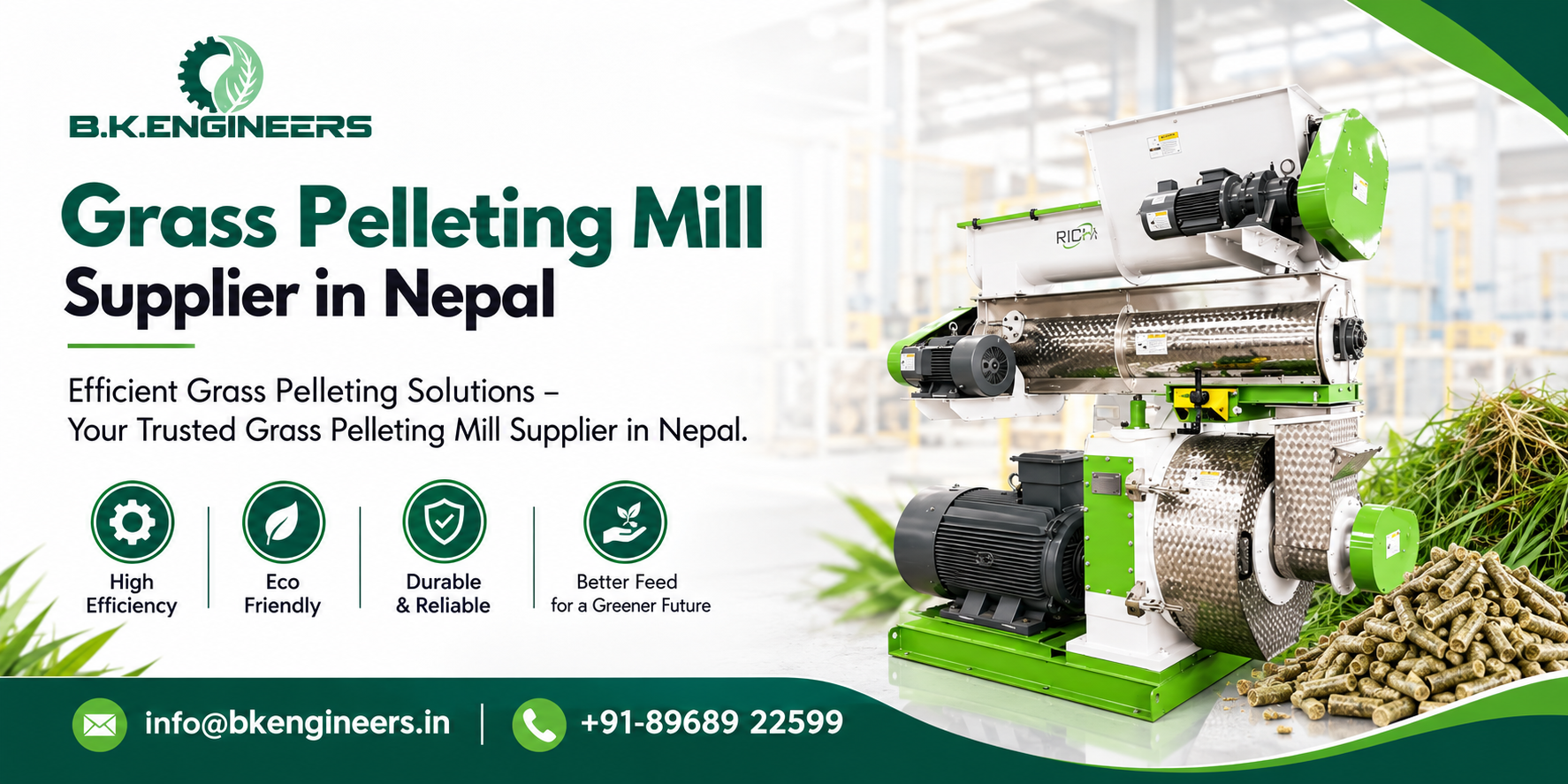
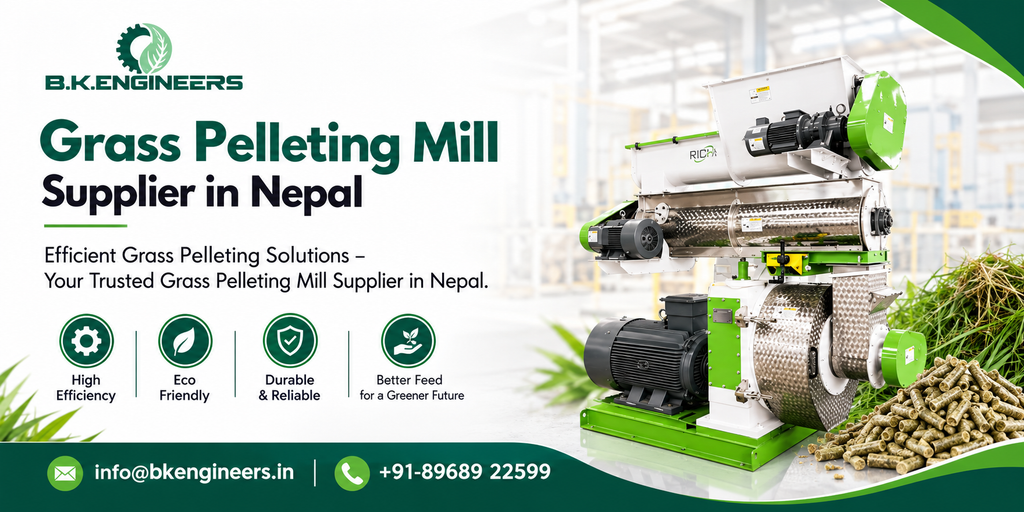
A grass pelleting mill is a machine used to compress processed grass into small, dense pellets. Depending on the application, the raw material may be dried, chopped, ground, mixed, and then fed into the pellet mill. During the pelleting process, pressure and heat help bind the material together. The final pellets are easier to handle, store, package, and transport compared with loose grass.
A properly designed grass pelleting mill can help businesses produce pellets with a more uniform size and shape. This makes the equipment useful for agricultural, livestock, biomass, and feed-processing applications. A suitable grass pelleting machine can help improve production consistency while reducing the manual effort involved in pellet preparation. We are the best Grass Pelleting Mill Provider.
Why Grass Pelleting Is Important in Nepal
- Nepal has a strong agricultural sector, and grass and other biomass materials are available in many regions. Farmers, feed producers, biomass businesses, and agricultural enterprises can benefit from processing these materials into useful pellet products.
- Easier storage and handling
- Better transportation efficiency
- Uniform pellet size
- Reduced material wastage
- Convenient packaging
- Improved material density
- Suitable for automated handling
- Better utilisation of agricultural biomass
- Grass pellets can also provide a practical way to utilise agricultural resources that may otherwise be wasted. By using suitable machinery, businesses can convert available biomass into a useful and marketable product.
Types of Grass Pelleting Mills
1. Flat Die Grass Pelleting Mill
A flat die grass pelleting mill is commonly considered for small- and medium-scale pellet production. It has a relatively simple construction and is easy to operate and maintain. The grass material is fed into the pelleting chamber, where rollers compress it through holes in a flat die to create pellets.
- Simple machine construction
- Easy operation
- Convenient maintenance
- Suitable for smaller production requirements
- Relatively compact installation
- Suitable for grass and other fibrous feed materials
Flat die machines can be particularly useful for farms, small feed businesses, and businesses starting grass pellet production. Some grass pellet equipment suppliers classify flat-die machines as small-capacity options, while ring-die machines are generally used for larger production requirements.
2. Ring Die Grass Pellet Mill
Ring die grass pelleting mills are designed for higher-capacity production. They are commonly used in commercial feed and biomass pellet plants where continuous and consistent production is required.
- High production capacity
- Continuous operation
- Uniform pellet formation
- Suitable for commercial production
- Strong construction for industrial applications
- Can be integrated into automated pellet plants
Ring die equipment is particularly relevant when a business in Nepal requires larger-scale grass pellet production. Commercial grass pellet systems can also include feeders, conditioners, coolers, screens, conveyors, dryers, and packaging equipment.
3. Small-Scale Grass Pelleting Mill
Small-scale grass pelleting mills are designed for farmers, small feed producers, and businesses with limited production requirements. Their compact design can make installation easier where workshop space is limited.
- Compact structure
- Lower production capacity
- Easy operation
- Suitable for smaller batches
- Lower space requirement
- Useful for farm-level production
4. Medium-Scale Grass Pelleting Mill
Medium-scale grass pelleting mills are suitable for growing feed businesses and commercial agricultural operations. They provide higher output than small machines while requiring less infrastructure than a large industrial pellet plant.
- Better production capacity
- Suitable for commercial operations
- Consistent pellet production
- Can support automated material handling
- Flexible raw-material processing
5. Large-Scale Industrial Grass Pelleting Mill
Large-scale grass pelleting mills are designed for industrial production where large quantities of grass or other biomass need to be processed continuously. These systems may use multiple pellet mills operating together with automated feeding, drying, cooling, storage, and packaging systems.
- High production capacity
- Continuous operation
- Automated feeding and handling
- Industrial-grade construction
- Integration with complete pellet plants
- Suitable for large commercial production
Applications of Grass Pelleting Mills
1. Cattle Feed Production
One of the major applications of a grass pelleting mill is the production of nutritious cattle feed. Grass, hay, alfalfa, and other suitable forage materials can be processed into compact pellets for dairy cows, buffaloes, calves, and other cattle.
Pellets are easier to measure, transport, and store than loose forage. A properly formulated feed pellet can also combine grass with grains, minerals, and other feed ingredients according to the nutritional requirements of the animals.
2. Dairy Farming
Dairy farms can use grass pellet production equipment to prepare convenient forage-based feed. Nepal’s dairy sector includes cattle and buffalo farming, creating demand for practical feed-processing solutions.
Grass pellets can help farmers handle forage in a more organised form and simplify storage and feeding operations. Depending on the formulation, pellets can be produced as part of a balanced feeding program.
3. Goat and Sheep Feed
Goat and sheep farms can also use grass-based pellets as part of their feeding systems. Materials such as hay, alfalfa, and suitable grasses can be processed into pellets that are easier to handle than loose forage.
Grass pellet machines are particularly useful where farmers need a consistent form of feed throughout the year. Grass-based pellets can be produced for ruminants including cattle, sheep, goats, and other livestock.
4. Poultry and Livestock Feed
Depending on the formulation and processing system, grass materials can be combined with grains and other ingredients to manufacture feed pellets for different livestock applications. Grass pellet technology can therefore be incorporated into diversified feed production facilities.
For commercial operations, pellet production can provide a controlled method of processing raw materials into uniform feed products.
5. Alfalfa Pellet Production
Alfalfa is an important forage material for animal feed. A grass pelleting mill can process suitable alfalfa material into compact pellets that are easier to package, transport, and store.
Alfalfa pellets can be used as a convenient forage ingredient for livestock. The exact formulation and pellet specifications can be adjusted according to the intended animal and feeding requirements.
6. Hay Pellet Production
Loose hay can occupy considerable storage space and may be difficult to transport over long distances. A grass pelleting mill can compress suitable dried hay into dense pellets.
This application is useful for farms and feed businesses that want a more compact form of forage. The resulting pellets can be packed into bags for easier handling and distribution.
7. Biomass Fuel Pellet Production
Grass pellet mills can also have applications beyond animal feed. Certain dried grasses and agricultural residues can be processed into biomass fuel pellets when the equipment and process are configured for that purpose. Grass-based biomass pellets can be considered for industrial heating and other suitable thermal-energy applications.
In Nepal, agricultural-residue pelletisation has also been explored as a way to convert crop residues into useful fuel products.
8. Agricultural Waste Utilisation
Agricultural activities can generate materials such as straw, dry grass, and other residues. Instead of leaving suitable residues unused, pelletising technology can help convert them into useful products.
A properly designed pellet production system can include preparation, drying, grinding, pelleting, cooling, screening, and packaging stages according to the raw material and final application.
9. Commercial Feed Mills
Commercial feed manufacturers can use grass pelleting mills as part of larger feed-processing plants. Such facilities may process grass together with grains, straw, or other approved ingredients.
Modern pellet production systems can be designed according to required production capacity, raw-material characteristics, pellet size, and level of automation. This allows manufacturers to select equipment according to their production requirements.
10. Small and Medium Farm Operations
Grass pellet machines can also be useful for small and medium-sized agricultural businesses. Farmers who have access to grass or forage materials can process these materials into pellets instead of depending entirely on loose feed.
The appropriate machine size depends on factors such as available raw material, required production volume, moisture level, desired pellet size, and intended use.
Benefits of Grass Pelleting Mill
1. Efficient Grass Processing
A grass pelleting mill is designed to process prepared grass material and convert it into compact pellets. This makes it easier to handle large quantities of grass in a systematic way. A reliable Grass Pelleting Mill Supplier in Nepal can provide equipment designed according to the required production capacity and material characteristics.
2. Better Material Utilisation
Loose grass can be difficult to store and transport efficiently. Pelleting helps convert the material into a denser form, allowing businesses to make better use of available biomass. This can also help reduce losses associated with improper handling and storage.
3. Consistent Pellet Size
A good-quality pelleting mill produces pellets with relatively uniform dimensions when properly operated and maintained. Consistent pellet size can make the final product easier to package, store, transport, and use.
4. Easy Storage and Handling
Loose grass requires considerable storage space and can be difficult to move. Grass pellets are compact and easier to handle. Businesses can organise their storage areas more effectively and simplify loading and transportation operations.
5. Reduced Transportation Requirements
Because pelleted grass is more compact than loose biomass, transportation can become more convenient. More material can potentially be handled within the same storage or transport volume, depending on pellet density and operating conditions.
6. Improved Production Efficiency
Modern pelleting mills can support continuous and organised production. With appropriate feeding, conditioning, pelleting, and cooling arrangements, businesses can establish a smoother workflow and reduce unnecessary manual handling.
7. Suitable for Different Grass Materials
Depending on the machine design and preparation process, pelleting mills can work with different types of grass and fibrous biomass. A professional supplier can help select suitable machinery based on the raw material, moisture content, required pellet size, and production target.
8. Helps Reduce Biomass Waste
Grass and agricultural residues may otherwise be difficult to utilise effectively. Converting suitable biomass into pellets provides a practical way to put these materials to productive use. This can support better resource utilisation and help businesses reduce avoidable material waste.
9. Flexible Production Capacity
Different businesses have different production requirements. A dependable Grass Pelleting Mill Supplier in Nepal can offer or recommend equipment based on small, medium, or larger-scale production needs. Selecting the appropriate capacity helps avoid purchasing machinery that is either insufficient or unnecessarily large.
10. Improved Product Value
Pelletizing can transform loose grass biomass into a standardised, easier-to-handle product. Depending on its intended application and quality, this can create additional commercial opportunities for businesses involved in biomass processing and related industries.
Why Choose B.K. Engineers
1. High-Quality Grass Pelleting Machinery
A professional supplier provides machines manufactured with suitable materials and robust components for continuous production. A properly designed grass pellet mill should be capable of handling fibrous materials efficiently while producing reasonably uniform pellets. Modern grass pellet mills can be configured for different raw materials and pellet sizes according to production requirements.
2. Suitable for Different Grass Materials
Grass materials can differ considerably in fibre content, moisture, density, and particle size. Therefore, a good supplier should understand the characteristics of the customer’s raw material before recommending equipment.
Grass pellet mills can be designed to process materials such as hay, alfalfa, forage grass, straw, rice husk, and other suitable biomass materials. This flexibility allows businesses to select machinery according to the materials that are locally available in Nepal.
3. Customised Capacity Options
Every business has different production requirements. A small livestock farm may need a compact pellet mill, while a commercial feed or biomass operation may require a larger production line.
Modern suppliers offer different machine capacities, allowing customers to select equipment based on their required output, available space, budget, and raw-material supply. Grass pellet systems can range from small-scale operations to larger industrial production lines.
4. Efficient Pellet Production
Grass is a relatively light and fibrous raw material, so specialised feeding and pelletizing arrangements can be useful. Some modern grass pellet mills use forced-feeding systems to improve material flow and reduce problems associated with fluffy raw materials.
An efficient machine can help convert loose grass into compact pellets that are easier to handle, store, transport, and package.
5. Multiple Applications
Grass pellets can have different applications depending on their formulation and quality. They may be produced as livestock feed for animals such as cattle, sheep, goats, and other ruminants. Certain grass and biomass pellets can also be used as fuel in suitable heating or energy applications. Therefore, investing in a suitable pelleting machine can support different business opportunities.
6. Better Handling and Storage
Loose grass occupies considerable storage space and can be difficult to transport efficiently. Pelletizing compresses the material into smaller, more uniform pieces.
This can make finished pellets easier to package, move, and store. Proper cooling and handling after pelletizing are also important for maintaining pellet quality before packaging.
7. Complete Pellet Production Solutions
An experienced Grass Pelleting Mill Supplier in Nepal can provide more than just the main pellet mill. Depending on the project, a complete production line may include material preparation, crushing, drying, pelletizing, cooling, screening, conveying, and packaging equipment.
Having these systems properly matched can make the complete production process more organized and efficient.
8. Installation and Technical Support
Technical support is an important factor when purchasing industrial machinery. Proper installation, operator training, maintenance guidance, and access to spare parts can help businesses operate equipment correctly.
Complete grass pellet production suppliers may provide installation assistance and operator training as part of their service. This type of support can be particularly useful for businesses starting a new pellet production project.
9. Reduced Material Waste
An appropriately selected pellet mill can help improve the conversion of prepared raw material into usable pellets. Pellet production also creates a more manageable form of material compared with loose grass.
Choosing the correct die, compression conditions, raw-material preparation, and moisture level is important for producing stable pellets. The raw material should be prepared according to the requirements of the selected machine and final product.
10. Support for Sustainable Agriculture
Grass and agricultural residues can be converted into useful products instead of being left unused. Pelletisation can therefore support better utilisation of available biomass resources.
Nepal has already explored agricultural crop-residue pelletisation projects, including initiatives aimed at developing pellet production and markets in the Terai region.
How to Select the Right Grass Pelleting Mill
Selecting a pellet mill should be done carefully. Before purchasing equipment, businesses should evaluate several factors. First, identify the exact raw material that will be processed. Different materials behave differently during pelletizing.
Second, determine the required production capacity. A machine should be selected according to the expected production requirement rather than simply choosing the largest available model. Third, consider the desired pellet size. Different applications may require different pellet dimensions.
Fourth, check the moisture content and preparation requirements of the raw material. Proper preparation can have a significant effect on pellet quality. Finally, consider machine construction, maintenance requirements, spare parts availability, operating conditions, and technical support.
Conclusion
Grass pelleting is a practical method for converting suitable grass and biomass materials into compact and easy-to-handle pellets. It can support agricultural businesses, livestock farms, biomass processors, and commercial pellet producers by improving material handling, storage, and transportation.
For businesses searching for a dependable Grass Pelleting Mill Supplier in Nepal, B.K. Engineers offers reliable engineering solutions for pelleting requirements. With suitable machinery and proper processing practices, businesses can make better use of available grass and biomass resources while developing an efficient pellet production process. We are the best Grass Pelleting Mill Provider in Punjab.
B.K. Engineers is committed to providing practical machinery solutions that support productivity, consistent processing, and long-term industrial requirements. For your grass pelleting needs, choosing the right machine and supplier can be an important step toward building a reliable and efficient pellet production operation.