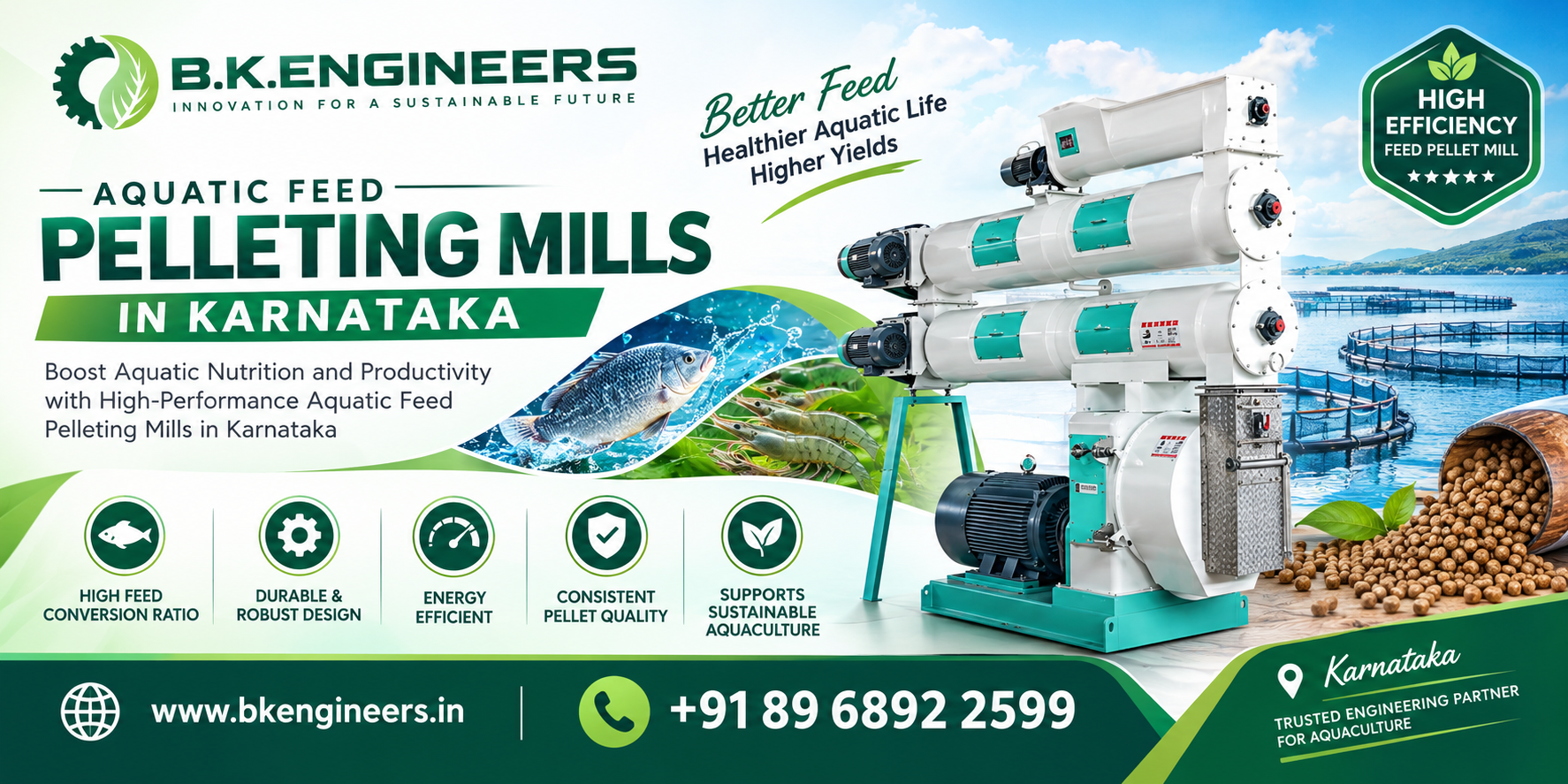
Aquatic Feed Pelleting Mills in Karnataka
Introduction
At B.K. Engineers, precision engineering is at the heart of everything we do, with your production goals guiding every decision. With over 56 years of experience and a strong commitment to quality, we work closely with you to build solutions that fit seamlessly into your operations. From complete feed mills to individual machines like hammer mills, mixers, and pellet mills, our technology supports cattle, poultry and aquatic feed production, optimising every stage of your line.
Aquaculture is an important part of the agriculture and food production industry. Fish farming and shrimp farming are growing rapidly because people need a regular supply of healthy and nutritious seafood. To support this growth, fish farmers need high-quality aquatic feed that provides the right nutrients for the healthy growth of aquatic animals. This is where Aquatic Feed Pelleting Mills in Karnataka play an important role.
Aquatic feed pelleting mills are specially designed machines that convert a prepared mixture of raw materials into small, uniform pellets. These pellets are used to feed fish, shrimp, and other aquatic animals. Good-quality feed helps farmers manage feeding more effectively, reduce feed waste, and maintain better farming practices.
B.K. Engineers provides industrial pelleting mill solutions for businesses looking for efficient feed processing equipment. With a focus on practical engineering and reliable machinery solutions, B.K. Engineers aims to support feed manufacturers and businesses that want to improve their production processes.
What Are Aquatic Feed Pelleting Mills
Aquatic feed pelleting mills are machines used to manufacture pellets from a mixture of ingredients such as fish meal, soybean meal, grains, vegetable proteins, oils, vitamins, and minerals. The ingredients are first prepared and mixed according to the nutritional requirements of the aquatic animals.
The pelleting process compresses prepared feed material through a die to create pellets of a required size and shape. Depending on the type of aquatic feed being produced, the process may also involve grinding, mixing, conditioning, drying, and cooling.
The prepared mixture is then processed through a pelleting system to produce pellets of the required size and shape. Depending on the machine design and feed formulation, additional processes such as conditioning, drying, cooling, and screening may be required.
Importance of Aquatic Feed Pelleting Mills in Karnataka
1. Consistent Feed Quality
Uniform pellets make it easier to manage feeding practices. A properly configured machine can help produce pellets with consistent dimensions, depending on the raw materials and operating conditions.
2. Better Feed Management
Pellets that are designed for the target aquatic species can make feeding more convenient. Suitable pellet size and water stability help farmers manage feed distribution and monitor consumption.
3. Efficient Production
Mechanical pelleting helps businesses process prepared feed mixtures in a structured and repeatable manner. The right machine can support regular production and reduce dependence on manual pellet-making methods.
4. Reduced Material Waste
Correct formulation, pellet quality, and handling can help reduce broken pellets and unused feed. This is important because feed is a major operating expense in aquaculture.
5. Support for Business Growth
Feed manufacturers can choose equipment according to their current production needs and future expansion plans. A suitable pelleting system can help them serve more customers as demand increases.
Types of Aquatic Feed Pelleting Mills
1. Floating Fish Feed Production Systems
Floating feed systems generally use extrusion technology to produce pellets that remain on the water surface for a suitable period. These systems can help farmers observe feeding activity and identify uneaten feed.
Floating fish feed production typically requires an extruder, suitable moisture and temperature control, drying equipment, and other supporting machinery.
2. Sinking Fish Feed Pelleting Mills
Sinking feed pellets are designed to move below the water surface. They are useful for aquatic species that feed at lower water levels.
The pellet density and water stability depend on the formulation and processing method. Conventional pellet mills may be used for certain sinking feeds, while other formulations may require extrusion or additional processing.
3. Shrimp Feed Production Equipment
Shrimp feed requires careful control over pellet size, durability, and water stability. Shrimp often feed slowly, so pellets must maintain their quality in water for the required feeding period.
Specialised feed production systems may be needed to achieve the desired specifications.
4. Small-Scale Aquatic Feed Mills
Small-scale mills are suitable for businesses with limited production requirements, research facilities, and smaller feed manufacturing operations.
These machines can be considered by entrepreneurs who want to enter the aquatic feed industry with a production capacity suited to their business plan.
5. Industrial Aquatic Feed Production Lines
Large-scale production lines may include grinding, mixing, conditioning, pelleting or extrusion, drying, cooling, screening, and packaging equipment.
The complete setup depends on the feed type, production target, automation level, and quality standards.
Applications of Aquatic Feed Pelleting Mills
1. Fish Feed Manufacturing
Aquatic feed pelleting mills are widely used to manufacture feed for different fish species, including tilapia, catfish, carp, and other freshwater fish. The machines process ingredients such as fish meal, soybean meal, grains, vitamins, and minerals into pellets that support healthy fish growth.
2. Shrimp and Prawn Feed Production
Shrimp and prawn farming requires specially formulated feed with suitable protein and nutrient levels. Pelleting mills help produce uniform feed pellets that are convenient to handle and distribute in aquaculture ponds. Pellet size and water stability can be adjusted according to the feed formulation and equipment design.
3. Commercial Aquaculture Farms
Commercial fish farms require a regular supply of feed to maintain production and improve farm management. Aquatic feed pelleting mills help feed manufacturers produce feed in different quantities and sizes, depending on the requirements of the farm.
4. Floating and Sinking Feed Production
Depending on the machine configuration and processing method, aquatic feed production lines can manufacture floating, slow-sinking, or sinking feed. This allows farmers to select feed according to the feeding habits of different aquatic species.
5. Feed for Different Growth Stages
Fish and shrimp require different pellet sizes during their growth stages. Aquatic feed pelleting mills can produce various pellet sizes using suitable dies and processing settings. Smaller pellets are suitable for young fish, while larger pellets can be used for mature fish.
6. Aquaculture Feed Processing Units
Feed manufacturers can use these mills as part of a complete production line that includes grinding, mixing, conditioning, pelleting, cooling, screening, and packing. This integrated process helps maintain consistent feed quality and improves production efficiency.
7. Agricultural and Aqua-Farming Businesses
Agricultural entrepreneurs and aquaculture businesses in Karnataka can use aquatic feed pelleting mills to establish or expand feed production facilities. Choosing suitable machinery helps businesses manage production capacity, raw material usage, and operating costs.
8. Commercial Feed Supply and Distribution
Feed manufacturers supplying fish farms, distributors, and aquaculture dealers need pellets with consistent size and quality. Aquatic feed pelleting mills support bulk production and help businesses meet different customer requirements.
Key Features to Consider When Selecting an Aquatic Feed Pelleting Mill
Before purchasing a machine, buyers should compare important technical and operational factors.
Production capacity: Select a machine according to the required output per hour and the expected working schedule.
Pellet size: Check whether the equipment can produce the pellet diameters needed for different fish or shrimp growth stages.
Raw material compatibility: Confirm that the machine can process the intended ingredients and feed formulations.
Power consumption: Review the motor rating and expected energy requirements to estimate operating costs.
Pellet durability: Consider whether the machine and production process can achieve the required pellet strength and water stability.
Maintenance requirements: Ask about spare parts, cleaning procedures, routine servicing, and access to technical support.
Complete production setup: Determine whether you need only a pelleting machine or a complete line with grinding, mixing, drying, cooling, and packing facilities.
Why Choose B.K. Engineers
1. Efficient Feed Production
Aquatic feed pelleting mills are designed to produce fish feed pellets in different sizes according to the requirements of various aquatic species. These machines help manufacturers process feed ingredients into consistent pellets, making production more organised and efficient.
2. Uniform Pellet Quality
Consistent pellet size and shape are important for modern aquaculture. A suitable pelleting mill helps produce uniform feed pellets when the ingredients, moisture content, and machine settings are properly controlled. Uniform pellets also make feed handling and distribution easier.
3. Suitable for Different Aquatic Feed Requirements
Aquatic Feed Pelleting Mills in Karnataka can be selected for different fish feed production needs. Depending on the machine configuration, they may be used to manufacture feed for different fish species and farming systems. Buyers should consider the required pellet diameter, production capacity, and feed formulation before choosing a machine.
4. Improved Production Efficiency
Modern pelleting equipment can help streamline the feed manufacturing process by reducing manual handling and supporting continuous production. The actual output depends on the machine model, raw materials, pellet size, and operating conditions.
5. Easy Operation and Maintenance
A well-designed aquatic feed pelleting mill should be easy to operate, clean, and maintain. Regular lubrication, inspection of moving parts, and timely replacement of worn components help maintain reliable performance and extend the machine’s service life.
6. Cost-Effective Manufacturing
Investing in suitable pelleting machinery can help businesses manage feed production more efficiently. Buyers should compare power consumption, production capacity, maintenance requirements, spare-part availability, and the total cost of ownership before making a purchase.
7. Reduced Material Handling
Pelleting machinery helps organise feed processing by converting prepared ingredients into a more manageable pellet form. When combined with suitable mixing, drying, cooling, and conveying equipment, it can support a smoother feed production line.
8. Customisation Options
Depending on the manufacturer, aquatic feed pelleting mills may be available with different die sizes, motor capacities, and production configurations. Buyers should choose specifications according to the type of feed, pellet diameter, moisture level, and required output.
9. Reliable Long-Term Investment
A quality aquatic feed pelleting mill can support stable production when operated and maintained correctly. Before purchasing, check the machine’s construction, warranty, technical assistance, and availability of replacement parts.
Frequently Asked Questions (FAQs)
1. What are aquatic feed pelleting mills used for
They process prepared feed ingredients into pellets for fish, shrimp, and other aquatic animals.
2. How do I choose an aquatic feed pelleting mill in Karnataka
Consider production capacity, feed type, pellet size, raw materials, energy consumption, maintenance needs, and the level of automation required.
3. What is the difference between floating and sinking fish feed
Floating feed remains near the water surface for a suitable period, while sinking feed moves below the surface. The appropriate type depends on the aquatic species and its feeding behaviour.
4. Can one machine produce feed for different aquatic species
Some equipment can accommodate different formulations and pellet sizes within its operating limits. However, species-specific feed may require changes in processing conditions or specialised machinery.
5. What equipment is needed for an aquatic feed production line
Depending on the process, a production line may include grinders, mixers, conditioners, pellet mills or extruders, dryers, coolers, screens, and packaging machines.
6. Why is pellet quality important in aquaculture?
Suitable pellet size, durability, and water stability can support feeding management and help reduce feed losses.
7. Why contact B.K. Engineers for pellet mill requirements
B.K. Engineers can be approached to discuss machinery requirements and identify a suitable configuration based on the intended application and production goals.
8. What information should I provide before purchasing a pelleting mill
Share the type of aquatic feed, target production capacity, required pellet size, available space, raw materials, and whether you need a standalone machine or a complete production line.
Conclusion
Aquaculture businesses need reliable feed production methods to support the growing demand for fish and shrimp feed. Aquatic Feed Pelleting Mills in Karnataka can help feed manufacturers process prepared ingredients into convenient pellets suited to their target aquatic species.
B.K. Engineers can be approached to discuss aquatic feed pelleting mill requirements and identify machinery solutions suited to a particular production project. By selecting appropriate equipment and following proper operating and maintenance practices, businesses can work towards consistent feed quality and efficient production.