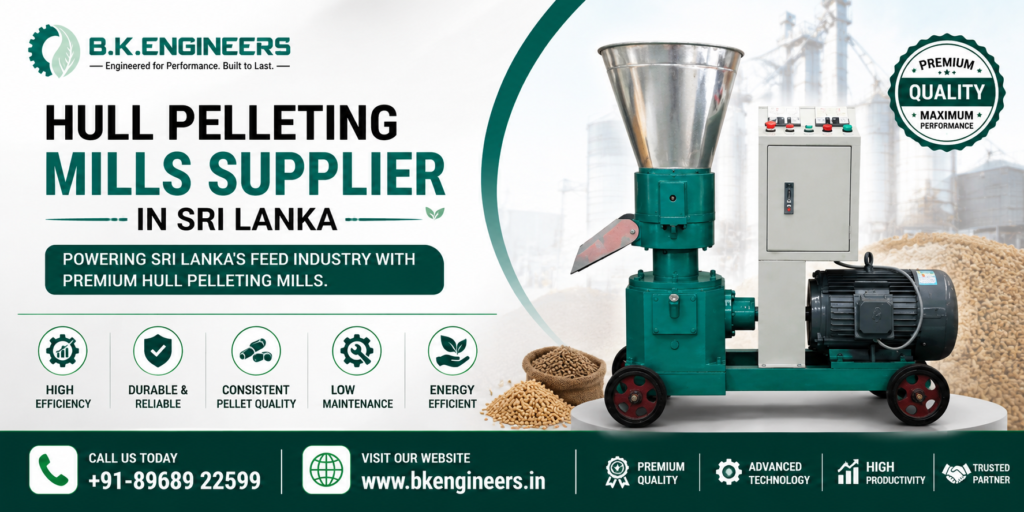
Hull Pelleting Mills Supplier in Sri Lanka
Introduction
At B.K. Engineers, we specialise in manufacturing a wide range of mills designed to meet your diverse needs. Our expertise spans across Cattle Feed Mills, Poultry Feed Mills, Aquatic Feed Mills, Bran Pelleting Mills, Hull Pelleting Mills, Grass Pelleting Mills, Alfalfa Pellets Mills, Wood Pellets Mills, and Straw Pelleting Mills. With our state-of-the-art technology and commitment to quality, we ensure that you get the best equipment for your production needs.
The demand for biomass fuel, animal feed, and agricultural processing equipment is increasing rapidly in Sri Lanka. Businesses are looking for efficient machines that can convert agricultural waste into valuable products. One of the most important machines used for this purpose is the Hull Pelleting Mill.
Suppose you are searching for a trusted Hull Pelleting Mill supplier in Sri Lanka; B.K. Engineers is your reliable partner for premium-quality pelleting machines designed to deliver outstanding performance, durability, and efficiency. B.K. Engineers is one of the leading manufacturers and suppliers of Hull Pelleting Mills, offering advanced pellet production solutions designed for high productivity and long service life. Our machines are built using modern technology and premium-quality materials to ensure smooth operation, low maintenance, and excellent pellet quality. We are the best Hull Pelleting Mills Manufacturer.
B.K. Engineers is your dependable partner if you’re searching for a reputable supplier of hull pelleting mills in Sri Lanka. For a variety of industrial applications, we produce and supply top-notch hull pelleting mills that offer superior performance, longevity, and reliable pellet production. Selecting the best pelleting mill may greatly increase your production efficiency and product quality, whether you are building a new feed production facility or modernising your current equipment.
What is a Hull Pelleting Mill
A Hull Pelleting Mill is a specialised machine designed to convert loose agricultural materials, husks, hulls, biomass, and feed ingredients into compact pellets. The machine compresses raw materials under high pressure through specially designed dies to produce uniform pellets. These pellets are easier to store, transport, and use. They also help minimise material wastage while improving handling and feeding efficiency. Hull pelleting mills are widely used in livestock feed manufacturing, biomass fuel production, poultry feed plants, cattle feed processing, and agricultural industries. We are the best Hull Pelleting Mills Provider.
- Biomass fuel
- Industrial boiler fuel
- Animal bedding
- Power generation fuel
- Industrial heating applications
- Renewable energy production
The machine applies high pressure to biomass materials, converting loose waste into compact pellets without compromising quality. Hull Pelleting Mills are widely used in industries processing rice husk, coffee husk, coconut shell powder, groundnut shells, sawdust, wheat husk, and other agricultural residues. With the growing focus on renewable energy in Sri Lanka, pellet manufacturing has become a profitable investment.
Why Choose B.K. Engineers
High-Quality Manufacturing Standards
- A trusted Hull Pelleting Mills Supplier in Sri Lanka offers machines manufactured using premium-grade raw materials and advanced engineering techniques. These pellet mills are designed to withstand continuous operation in demanding industrial environments. The use of robust components ensures durability, minimal wear and tear, and consistent pellet production.
Efficient Pellet Production
- Modern hull pelleting mills are designed to deliver high output while maintaining excellent pellet quality. They convert agricultural residues such as rice husk, groundnut shells, coconut husk, sunflower husk, and other biomass materials into uniform pellets. Efficient pellet production helps reduce waste and increases profitability for businesses.
Energy-Efficient Operation
- One of the biggest advantages of choosing a reliable supplier is access to energy-efficient machinery. Advanced pelleting mills consume less power while producing higher output, helping manufacturers reduce electricity costs. Lower energy consumption also supports environmentally friendly production practices.
Custom Solutions for Different Industries
- Every industry has different pellet production requirements. A professional Hull Pelleting Mills Supplier in Sri Lanka provides customised solutions based on production capacity, raw material type, and customer requirements. Whether you need a small-scale machine or a fully automated production line, customised equipment ensures optimal performance.
Superior Pellet Quality
- High-quality pellet mills produce dense, uniform, and durable pellets that are easier to transport, store, and use. Consistent pellet size improves combustion efficiency in biomass applications and enhances feed quality in the livestock industry. Better pellet quality also increases customer satisfaction and market value.
Low Maintenance Requirements
- Reliable pelleting mills are designed for easy maintenance and long service life. Wear-resistant rollers, dies, and heavy-duty bearings reduce maintenance frequency and downtime. Easy access to machine components allows quick inspection and replacement, ensuring uninterrupted production.
Advanced Technology and Automation
Leading suppliers integrate modern technology into their pelleting mills, including automated feeding systems, temperature monitoring, pressure control, and safety mechanisms. Automation minimises manual labour, improves production accuracy, and enhances overall operational efficiency.
Cost-Effective Investment
- Purchasing machinery from a trusted Hull Pelleting Mills Supplier in Sri Lanka provides long-term value. High-quality equipment offers better efficiency, lower maintenance costs, reduced energy consumption, and longer operational life, resulting in an excellent return on investment.
Strong After-Sales Support
- Professional suppliers offer installation assistance, operator training, technical guidance, maintenance services, and readily available spare parts. Reliable after-sales support helps minimise downtime and ensures smooth machine operation throughout its lifespan.
Increased Productivity
- Modern hull pelleting mills operate continuously with high production capacity. Faster processing speeds and consistent output enable businesses to meet growing market demand while maintaining product quality.
Environmentally Friendly Solution
- Pelleting agricultural waste helps reduce environmental pollution by converting biomass residues into valuable fuel and feed products. Using hull pelleting mills supports sustainable manufacturing practices and promotes efficient waste management.
Easy Operation
- User-friendly control panels and automated operating systems make these machines simple to use. Operators require minimal training, reducing labor costs while maintaining efficient production.
Reliable Performance
- Industrial-grade hull pelleting mills are built to perform consistently even under heavy workloads. Their sturdy construction ensures stable operation, reduced vibration, and dependable production throughout long working hours.
Eco-Friendly Biomass Processing
- Hull pelleting mills support sustainable manufacturing by converting agricultural waste into valuable biomass fuel. This helps reduce environmental pollution, minimises waste disposal issues, and promotes the use of renewable energy sources.
Customised Industrial Solutions
- Experienced suppliers understand that every business has unique production requirements. They provide customised pelleting mill solutions, technical consultation, installation assistance, and after-sales support to ensure maximum operational efficiency.
Applications of Hull Pelleting Mills
1. Animal Feed Manufacturing
- Hull pelleting mills are extensively used to process rice hulls, soybean hulls, sunflower hulls, peanut shells, and other agricultural residues into nutritious animal feed pellets. Pelleted feed improves digestibility, minimises feed wastage, and ensures balanced nutrition for cattle, poultry, goats, sheep, and other livestock.
2. Biomass Fuel Pellet Production
- Sri Lanka is increasingly adopting renewable energy solutions, and hull pelleting mills play a key role in producing biomass fuel pellets from agricultural waste. These pellets are used in industrial boilers, heating systems, biomass power plants, and commercial furnaces, offering a sustainable alternative to fossil fuels.
3. Agricultural Waste Recycling
- Large quantities of rice husks, coconut husks, coffee husks, and other crop residues are generated every year. Hull pelleting mills convert these wastes into valuable products, reducing environmental pollution while creating additional income opportunities for farmers and agro-industries.
4. Livestock Farming
- Pelleted hull products are widely used in dairy farms, poultry farms, and livestock operations across Sri Lanka. Uniform pellets improve feed intake, simplify feeding operations, reduce dust generation, and enhance overall animal health and productivity.
5. Oilseed Processing Industries
- Soybean, sunflower, and other oilseed processing industries use hull pelleting mills to compress extracted hulls into compact pellets. These pellets are easier to transport, store, and market as animal feed ingredients or biomass fuel, increasing the value of by-products.
6. Commercial Feed Production Plants
- Feed manufacturers rely on hull pelleting mills for continuous, high-capacity pellet production with consistent pellet size and density. The technology supports efficient large-scale operations while maintaining high-quality feed standards.
7. Export-Oriented Biomass Pellet Industry
- High-density biomass pellets produced from hull materials are easier to package, store, and export. Their uniform quality and reduced moisture content make them suitable for international biomass fuel markets, including growing demand across Asia and Europe.
8. Sustainable Industrial Operations
- Hull pelleting mills help industries reduce waste disposal costs and improve resource utilisation. By converting agricultural residues into valuable pellets, companies support sustainable manufacturing practices and contribute to a circular economy while reducing carbon emissions.
9. Feed Processing Plants
- Commercial feed manufacturers integrate hull pelleting mills into complete feed production lines to manufacture uniform pellets with improved nutritional consistency, durability, and shelf life for livestock operations.
10. Sustainable Agricultural Processing
- Hull pelleting mills help farmers, agro-processing units, biomass companies, and feed manufacturers maximise the value of agricultural by-products. By converting low-value hulls into premium pellets, these machines improve profitability while supporting Sri Lanka’s sustainable agricultural and industrial development.
Specification Table of Hull Pelleting Mills
| Parameter | Specification |
|---|---|
| Material | Hull Pelleting Mill |
| Production Capacity | 1–15 Ton/Hour |
| Main Motor Power | 22–250 kW |
| Feeder Power | 1.5–3 kW |
| Conditioner Power | 5.5–15 kW |
| Pellet Diameter | 4–12 mm |
| Die Type | Ring Die |
| Drive System | Heavy Duty Gear Drive |
| Material | Mild Steel / Stainless Steel |
| Moisture Requirement | 10–15% |
| Lubrication System | Automatic |
| Control Panel | PLC / Semi-Automatic |
| Application | Hull, Husk, Feed & Biomass Pellets |
Benefits of Hull Pelleting Mills
1. Increases Bulk Density
Hull pelleting mills convert loose, lightweight hulls into compact pellets with higher bulk density. This significantly reduces the storage space required and allows businesses to maximise warehouse capacity while improving inventory management.
2. Reduces Transportation Costs
Pelletized hulls occupy less volume than loose materials, making transportation more efficient and economical. More material can be transported in a single shipment, reducing freight expenses and improving logistics for manufacturers and exporters.
3. Converts Agricultural Waste into Valuable Products
Hull pelleting mills help transform agricultural by-products into profitable products. Instead of disposing of hulls, businesses can convert them into biomass fuel pellets or animal feed ingredients, creating additional revenue streams while minimising waste.
4. Improves Material Handling
Pellets are easier to convey, package, load, unload, and store compared to loose hulls. The uniform shape and size improve flow characteristics and reduce handling difficulties throughout the production process.
5. Produces High-Quality Biomass Fuel
Pelletized hulls provide an efficient renewable fuel with consistent size, lower moisture, and improved combustion efficiency. They are commonly used in industrial boilers, heating systems, biomass power plants, and other energy applications.
6. Enhances Animal Feed Production
Soybean hulls, sunflower hulls, and similar agricultural by-products can be pelletized for livestock feed. Pelleting improves feed consistency, reduces dust, minimizes ingredient separation, and enhances feed handling efficiency.
7. Reduces Dust Generation
Loose hull materials often create excessive dust during handling and transportation. Pelletizing significantly minimizes airborne dust, resulting in a cleaner working environment, reduced product loss, and improved workplace safety.
8. Supports Eco-Friendly Manufacturing
Hull pelleting promotes sustainable manufacturing by recycling agricultural residues into useful products. It reduces environmental waste while supporting renewable energy production and circular economy initiatives.
9. Delivers Consistent Pellet Quality
Modern hull pelleting mills are engineered to produce pellets with uniform diameter, length, and density. This consistency improves product quality, customer satisfaction, and performance across industrial and agricultural applications.
10. High Production Efficiency
Advanced pelleting systems provide continuous operation with high throughput, low energy consumption, and reliable performance. This enables manufacturers to achieve greater productivity while reducing operating costs.
Types of Hull Pelleting Mills
1. Flat Die Hull Pelleting Mill
Flat die pelleting mills are suitable for small-scale production. They are easy to operate, require less maintenance, and are ideal for farmers and small industries.
- Compact design
- Low power consumption
- Easy installation
- Affordable maintenance
- Suitable for low-volume production
2. Ring Die Hull Pelleting Mill
Ring die pelleting mills are widely used in commercial and industrial production due to their high output and excellent pellet quality.
- High production capacity
- Continuous operation
- Superior pellet density
- Longer machine life
- Better efficiency
3. Biomass Hull Pelleting Mill
These machines are specially designed for biomass fuel production using agricultural waste materials.
- Biomass fuel plants
- Renewable energy projects
- Industrial boilers
- Power generation
4. Animal Feed Hull Pelleting Mill
These pelleting mills produce nutritious feed pellets for poultry, cattle, fish, and livestock.
- Uniform feed size
- Better nutrition
- Reduced feed wastage
- Easy digestion
Conclusion
Suppose you are looking for a dependable Hull Pelleting Mills Supplier in Sri Lanka, B.K. Engineers is your trusted partner for high-quality and efficient pelleting machinery. Our advanced Hull Pelleting Mills are engineered to provide reliable performance, excellent pellet quality, and long-term durability for biomass and agricultural processing industries. We are the best Hull Pelleting Mills Provider in Punjab.
Whether you need a machine for biomass fuel production, agricultural waste recycling, or animal feed manufacturing, B.K. Engineers offers the right solution tailored to your production needs. Backed by quality manufacturing, competitive pricing, and responsive customer support, we are committed to helping businesses in Sri Lanka improve productivity and achieve sustainable growth.