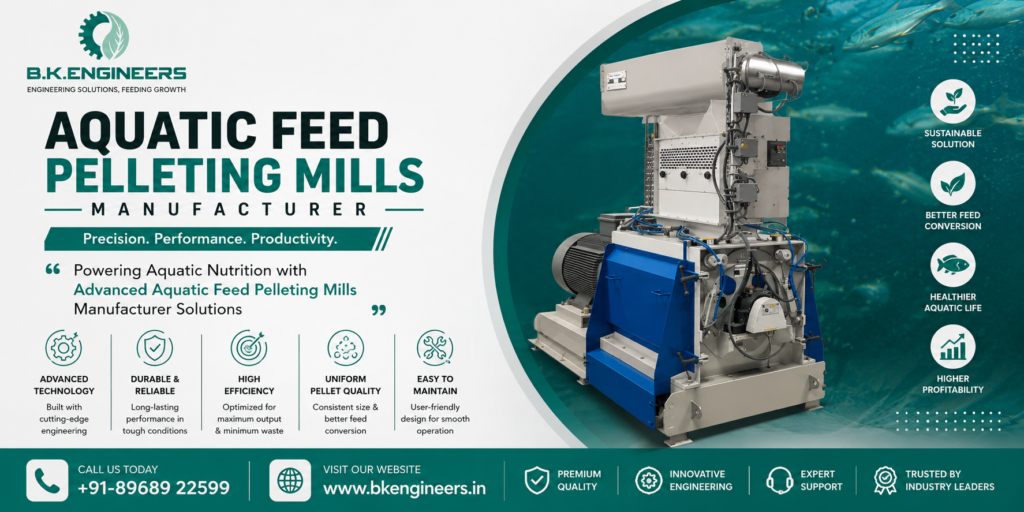
Aquatic Feed Pelleting Mills Manufacturer
Introduction
At B.K. Engineers, we specialize in manufacturing a wide range of mills designed to meet your diverse needs. Our expertise spans across Cattle Feed Mills, Poultry Feed Mills, Aquatic Feed Mills, Bran Pelleting Mills, Hull Pelleting Mills, Grass Pelleting Mills, Alfalfa Pellets Mills, Wood Pellets Mills, and Straw Pelleting Mills. With our state-of-the-art technology and commitment to quality, we ensure that you get the best equipment for your production needs.
Due to rising demand for fish, prawns, and other aquatic goods, the aquaculture sector is expanding quickly worldwide. One of the most crucial elements in maintaining healthy aquatic farming is the provision of balanced and nutrient-rich feed. Aquatic animals that are fed high-quality feed develop more quickly, have higher survival rates, and are more productive overall. B.K. Engineers is a trusted name in manufacturing advanced feed processing machinery and provides high-performance aquatic feed pelleting mills designed for modern aquaculture requirements. With strong engineering expertise, quality manufacturing, and customer-focused solutions, the company delivers machines that help feed manufacturers produce premium-quality aquatic feed efficiently.
In order to build and deliver cutting-edge equipment that transforms raw feed ingredients into small, robust, and easily digested pellets, an effective manufacturer of aquatic feed pelleting mills is essential. These devices guarantee consistent pellet size, enhanced feed performance, and higher nutrient retention. A reputable producer of aquatic feed pelleting mills, B.K. Engineers provides aquaculture sectors with dependable and creative feed processing solutions. The business offers cutting-edge technology, superior manufacturing, and customer-focused solutions.
What is an Aquatic Feed Pelleting Mill
- An aquatic feed pelleting mill is specialised machinery used for converting powdered feed ingredients into compressed pellets. These pellets are mainly used for feeding fish, shrimp, and other aquatic animals. The pelleting process involves mixing raw materials such as fish meal, soybean meal, grains, vitamins, minerals, and other nutritional ingredients. The mixture is then compressed through a die to form uniform pellets with required sizes and shapes.
- Better feed digestibility
- Reduced feed wastage
- Improved floating and sinking properties
- Enhanced nutritional value
- Consistent pellet quality
- These advantages make aquatic feed pelleting mills an essential part of modern aquaculture feed production plants. Unlike traditional feed processing methods, aquatic feed pelleting mills help maintain nutritional value while improving feed efficiency. The produced pellets have better water stability, easy digestion, and improved acceptance by aquatic animals. As a leading Aquatic Feed Pelleting Mills Manufacturer, B.K. Engineers designs machines that meet the specific needs of aquaculture feed producers.
Why Choose B.K. Engineers
1. High-Quality Pellet Production
A trusted Aquatic Feed Pelleting Mills Manufacturer focuses on delivering machines that produce uniform and high-density pellets. Proper pellet size, shape, and consistency are essential for aquatic animals as they directly affect feed consumption and growth rates.
- Consistent pellet diameter and quality
- Better nutrient retention
- Improved feed digestibility
- Reduced feed wastage
2. Advanced Technology and Modern Machinery
Experienced manufacturers use the latest technology to develop efficient aquatic feed pellet machines. Modern pelleting mills are designed with advanced control systems, energy-efficient motors, and precision-engineered components to ensure smooth operation.
- Better production capacity
- Improved pellet consistency
- Reduced energy consumption
- Easy operation and maintenance
3. Customised Solutions According to Requirements
Every aquaculture business has different production needs. A professional aquatic feed pelleting mill manufacturer offers customised solutions based on raw materials, production capacity, pellet size, and application requirements.
- Fish feed pellets
- Shrimp feed pellets
- Floating aquatic feed
- Sinking feed pellets
- Speciality nutritional feeds
4. Durable and Reliable Equipment
Aquatic feed production requires machines that can operate continuously under demanding conditions. A reputed manufacturer focuses on using high-quality raw materials and robust engineering techniques to build durable pelleting mills.
- Longer equipment lifespan
- Less downtime
- Lower maintenance costs
- Reliable performance during continuous production
5. Improved Production Efficiency
A reliable Aquatic Feed Pelleting Mills Manufacturer provides equipment designed to maximise production efficiency. Modern pellet mills optimise the entire pelleting process, including mixing, conditioning, compression, and pellet formation.
- Faster production cycles
- Minimum material loss
- Better utilisation of raw materials
- Consistent output quality
6. Energy-Efficient Production
Modern aquatic feed pellet mills are designed to consume less power while delivering higher production capacity. Energy-efficient machines help manufacturers reduce operational costs and increase overall profitability.
- Lower electricity consumption
- Faster production cycles
- Reduced processing costs
- Increased productivity
7. Expert Technical Support and After-Sales Service
Choosing an established manufacturer provides access to expert guidance and reliable after-sales support. Manufacturers assist customers with machine installation, operation training, maintenance advice, and spare parts availability.
- Smooth machine operation
- Quick troubleshooting
- Longer equipment lifespan
- Better productivity
8. Cost-Effective Long-Term Investment
Investing in a high-quality aquatic feed pelleting mill may require an initial investment, but it provides long-term benefits. Reliable machinery offers:
- Lower maintenance expenses
- Longer service life
- Reduced production losses
- Increased manufacturing capacity
- Better profitability
9. Better Production Capacity and Efficiency
A modern aquatic feed pelleting mill improves the overall efficiency of feed manufacturing plants. With automated operations and precise processing, manufacturers can achieve higher output with less manual effort.
- Continuous production
- Consistent pellet quality
- Reduced raw material wastage
- Faster processing speed
10. Compliance with Industry Standards
- Machine installation assistance
- Operator training
- Spare parts availability
- Maintenance support
- Troubleshooting services
Applications of Aquatic Feed Pelleting Mills
1. Fish Feed Production
- One of the major applications of aquatic feed pelleting mills is manufacturing fish feed pellets. These machines produce nutritious pellets suitable for freshwater and marine fish species such as tilapia, carp, catfish, trout, and other commercial fish varieties. The produced pellets offer excellent digestibility, proper size consistency, and reduced feed wastage.
2. Shrimp Feed Manufacturing
- Aquatic feed pelleting mills are widely used in shrimp farming industries for producing small-size, high-protein shrimp feed pellets. These pellets are designed to maintain stability in water, allowing shrimp to consume feed efficiently while minimising nutrient loss and maintaining water quality.
3. Floating Fish Feed Production
- Modern aquatic feed pelleting systems are used for manufacturing floating fish feed that remains on the water surface for longer periods. Floating pellets help farmers monitor feeding behaviour, reduce overfeeding, and improve feed management. These mills are commonly used in intensive fish farming operations.
4. Sinking Feed Production
- Aquatic Feed Pelleting Mills are also applied for producing sinking pellets suitable for bottom-feeding aquatic species. The machines provide accurate density control and uniform pellet formation, making them ideal for species that feed below the water surface.
5. Commercial Aquaculture Farms
- Large-scale aquaculture farms use aquatic feed pelleting mills to produce their own customised feed according to species requirements. These systems help reduce dependency on external feed suppliers and ensure consistent nutritional quality for better growth rates.
6. Fish Feed Manufacturing Industries
- Aquatic Feed Pelleting Mills are an essential part of industrial fish feed production plants. They can be integrated with grinding, mixing, extrusion, drying, cooling, coating, and packaging systems to create complete aquatic feed production lines.
7. Research and Speciality Feed Development
- Aquatic feed mills are also used in research facilities and specialised feed plants to develop customised diets for different aquatic species. They help produce experimental feeds with specific protein levels, vitamins, minerals, and functional ingredients.
8. Aquaculture Farms
- Large fish farms and aquaculture businesses install aquatic feed pelleting mills to produce their own feed requirements. This helps reduce dependency on external suppliers, lowers operational costs, and ensures consistent feed quality.
9. Export-Oriented Feed Production
- Modern aquatic feed pelleting mills help manufacturers produce internationally accepted aquafeed products with consistent quality, durability, and nutritional performance. These systems are suitable for companies supplying feed products to global aquaculture markets
Table Specifications of Aquatic Feed Pelleting Mills
| Specification | Details |
|---|---|
| Material | Aquatic Feed Pelleting Mills |
| Manufacturer | B.K. Engineers |
| Application | Fish Feed, Shrimp Feed, Aquatic Feed Production |
| Capacity Range | Customized as per requirement |
| Material | Heavy Duty Industrial Grade Material |
| Pellet Size | Customized According to Feed Requirement |
| Operation Type | Automatic / Semi-Automatic |
| Drive System | Energy Efficient Motor Drive |
| Suitable Raw Materials | Fish Meal, Soybean Meal, Corn, Grain Mixtures & Other Feed Ingredients |
| Pellet Type | Floating & Sinking Pellets |
| Control System | User-Friendly Control Panel |
| Maintenance | Low Maintenance Design |
| Construction | Strong and Durable Structure |
Benefits of Aquatic Feed Pelleting Mills
1. Produces High-Quality Feed Pellets
Aquatic feed pelleting mills produce uniform pellets with consistent size, density, and shape. Uniform pellets ensure that fish and shrimp receive balanced nutrition in every bite, leading to healthier growth and higher survival rates.
- Consistent pellet size
- Improved feed quality
- Better nutritional distribution
- Reduced feed segregation
2. Higher Feed Conversion Ratio
One of the biggest benefits of using an aquatic feed pelleting mill is improved feed conversion. Well-processed pellets are easier for aquatic animals to digest, allowing them to convert feed into body weight more efficiently. Proper pelleting and conditioning improve digestibility while reducing nutrient losses.
- Faster fish growth
- Lower feed consumption
- Reduced production costs
- Higher profitability
3. Better Water Stability
Aquatic feed pellets remain intact in water for a longer period, preventing rapid disintegration. This minimises nutrient leaching and reduces water pollution while allowing fish enough time to consume the feed.
- Less nutrient loss
- Cleaner ponds and tanks
- Reduced water contamination
- Improved water quality
4. Reduced Feed Wastage
Pelleted feed minimises the amount of feed lost during handling, transportation, and feeding. Strong, durable pellets resist breakage and generate fewer fines.
- Lower feed losses
- Better storage efficiency
- Cost savings
- Increased productivity
5. Improved Nutrient Availability
The pelleting process involves steam conditioning and compression, which improves starch gelatinization and protein digestibility. This helps aquatic animals absorb nutrients more effectively.
- Better digestion
- Increased nutrient absorption
- Improved immunity
- Enhanced growth performance
6. High Production Capacity
Advanced pelleting mills are designed for continuous production with minimal downtime.
- Automatic feeding
- Continuous pellet production
- High output rates
- Stable performance
- Low maintenance
7. Energy-Efficient Operation
Modern pelleting mills are engineered for efficient power consumption.
- Lower electricity costs
- Improved productivity
- Reduced operating expenses
- Sustainable manufacturing
8. Better Pellet Durability
High-quality pelleting machines produce pellets with excellent mechanical strength.
- Easy transportation
- Less breakage
- Better packaging
- Longer shelf life
9. Supports Commercial Aquaculture
Large-scale fish farms require consistent feed quality and continuous production. Aquatic feed pelleting mills help commercial farms meet increasing feed demand while maintaining quality standards.
- Commercial fish farms
- Shrimp farms
- Aquaculture companies
- Feed manufacturing plants
- Research institutions
10. Improved Farm Profitability
Better feed quality directly impacts production efficiency.
- Lower feed costs
- Faster harvesting
- Improved survival rates
- Higher market value
- Increased return on investment (ROI)
Types of Aquatic Feed Pelleting Mills
1. Flat Die Aquatic Feed Pellet Mill
Flat die pellet mills are commonly used for small and medium-scale aquatic feed production. These machines consist of a flat die and rollers that compress feed materials into pellets.
- Simple operation
- Compact design
- Easy maintenance
- Suitable for small production units
- Cost-effective solution
2. Ring Die Aquatic Feed Pellet Mill
Ring die pellet mills are widely used in large-scale commercial feed manufacturing plants. These machines offer high production capacity and excellent pellet quality.
- High output capacity
- Continuous production
- Better energy efficiency
- Strong pellet formation
- Suitable for industrial applications
3. Floating Feed Pellet Mill
Floating feed pellet mills are specially designed to manufacture floating aquatic feed pellets. These pellets remain on the water surface, allowing farmers to monitor feeding activity easily.
- Fish farming
- Tilapia feed production
- Catfish feed production
- Other floating feed applications
4. Sinking Feed Pellet Mill
Sinking feed pellet mills are designed to produce pellets that slowly sink in water. These are suitable for aquatic animals that feed below the water surface.
- Shrimp farming
- Bottom-feeding fish
- Aquatic species requiring sinking feed
5. Extruder-Based Aquatic Feed Pellet Mill
Extruder-based systems are advanced machines used for producing high-quality floating and semi-floating feed pellets. The extrusion process improves pellet expansion and water stability.
- Produces premium-quality pellets
- Better nutrient absorption
- Excellent floating ability
- Suitable for advanced aquaculture feed production
Conclusion
The growing demand for aquaculture products has increased the need for efficient and reliable feed production equipment. A high-quality Aquatic Feed Pelleting Mills Manufacturer helps businesses produce nutritious and durable feed pellets with improved efficiency.
B.K. Engineers is a trusted name in manufacturing advanced aquatic feed pelleting mills designed for excellent performance, durability, and cost-effective production. With innovative technology, customised solutions, and customer-focused services, the company supports feed manufacturers in achieving higher productivity and better quality standards.