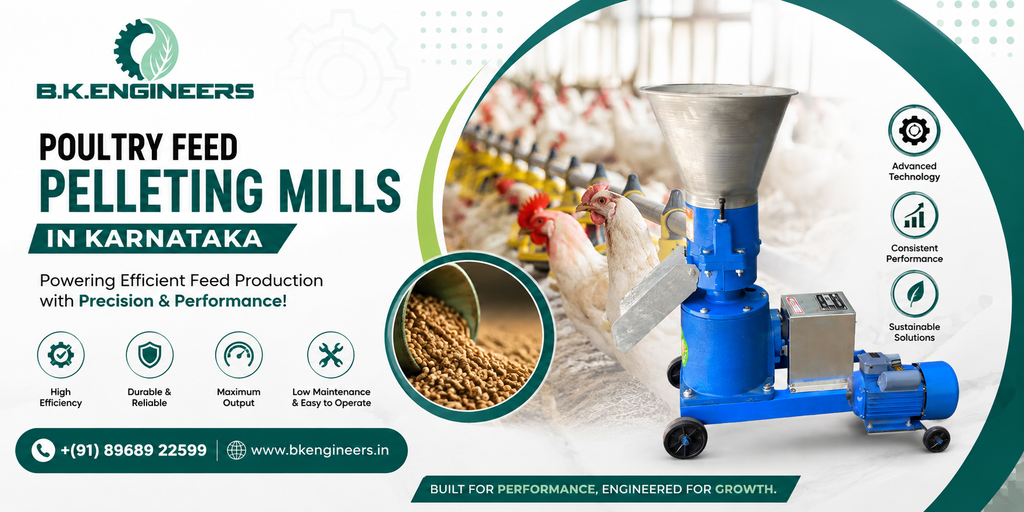
Poultry Feed Pelleting Mills in Karnataka
Introduction
At B.K. Engineers, precision engineering is at the heart of everything we do, with your production goals guiding every decision. With over 56 years of experience and a strong commitment to quality, we work closely with you to build solutions that fit seamlessly into your operations. From complete feed mills to individual machines like hammer mills, mixers, and pellet mills, our technology supports cattle, poultry and aquatic feed production, optimising every stage of your line.
The poultry industry in Karnataka is growing rapidly, creating a strong demand for quality poultry feed and efficient feed processing equipment. Poultry farmers and feed manufacturers need machines that can produce nutritious, uniform, and easy-to-handle feed pellets in large quantities. This is where Poultry Feed Pelleting Mills in Karnataka play an important role.
A poultry feed pelleting mill converts properly prepared feed ingredients into compact pellets. These pellets are easier to store, transport, and feed to poultry birds. With the right pelleting equipment, manufacturers can improve production efficiency, reduce feed wastage, and maintain consistent pellet quality.
B.K. Engineers is a trusted engineering company offering reliable feed processing and pelleting solutions for poultry and animal feed applications. With a focus on practical machine design, quality construction, and efficient performance, B.K. Engineers helps feed producers select suitable equipment according to their production requirements.
What Is a Poultry Feed Pelleting Mill
A poultry feed pelleting mill is a machine used to compress a prepared mixture of feed ingredients into pellets of a specific size and shape. Poultry feed may contain ingredients such as maize, wheat, soybean meal, rice bran, minerals, vitamins, and other nutritional components.
Before pelleting, the ingredients are generally cleaned, ground, mixed, and conditioned. The prepared mixture is then passed through the pellet mill, where pressure and heat help form compact feed pellets. The finished pellets can be cooled, screened, and packed for use on poultry farms or distribution to customers.
Why Are Poultry Feed Pelleting Mills Important
- Producing poultry feed in pellet form offers several practical advantages. Uniform pellets make feed easier to handle and distribute, especially in commercial poultry farms. Karnataka has a significant poultry and agricultural sector, making efficient feed production important for farmers and feed manufacturers. Good-quality pelleted feed can offer several practical advantages.
- Better feed handling and storage
- Reduced dust during feeding
- More uniform feed size
- Reduced ingredient segregation
- Efficient transportation
- Improved production consistency
- Better utilisation of feed ingredients
- The right pelleting equipment can therefore become an important part of an efficient poultry feed manufacturing system. Pellets provide a more uniform feed form and can help reduce selective feeding by birds. They are also easier to handle than loose feed and can reduce dust during transportation and feeding.
Why Choose B.K. Engineers
1. Better Feed Quality
- One of the biggest reasons to choose a poultry feed pelleting mill is the ability to produce more consistent feed. During conventional mash feeding, birds may selectively eat certain ingredients. Pelleting combines the ingredients into a compact form, helping ensure that nutrients are consumed more uniformly. A properly designed pelleting system can help feed manufacturers maintain consistent pellet size, density, and durability. This is particularly useful when producing different poultry feed formulations for broilers, layers, breeders, or other poultry requirements.
2. Reduces Feed Wastage
- Feed wastage can increase the overall cost of poultry production. Loose mash can create dust, scattering, and ingredient separation during feeding and handling. Pellets are compact and easier to handle, which can reduce spillage and wastage. Research and industry sources report reduced feed wastage and selective feeding as important advantages of pelleted diets.
3. Improved Feed Handling and Storage
- Pellet feed generally has a higher bulk density than loose mash. This means more feed can be handled or stored in a given volume. Pellets are also easier to transport through mechanical feeding and conveying systems. Their improved flow characteristics can make them suitable for modern poultry farms and automated feed distribution systems.
4. Better Nutrient Distribution
- A poultry feed formula may contain grains, protein sources, minerals, vitamins, additives, and other ingredients. In loose feed, some ingredients can separate during transportation or handling. Pelleting helps bind the mixed ingredients together. Each pellet can contain the formulated combination of ingredients, helping reduce selective feeding. This supports more uniform nutrient consumption across the flock.
5. Supports Feed Conversion Efficiency
- Feed conversion is an important consideration in poultry production because feed represents a major operating expense. Properly produced pellets can help birds consume feed efficiently and reduce feed losses. Studies and extension resources have reported improvements in feed intake, weight gain, and feed conversion when suitable pelleted diets are used for broilers.
6. Better Pellet Durability
- Good-quality pellets should be strong enough to withstand handling, transportation, and feeding without producing excessive fines. Pellet durability depends on several factors, including raw material quality, particle size, formulation, conditioning, die selection, and processing conditions. A well-designed pelleting mill, combined with proper conditioning and cooling, can help manufacturers produce pellets with suitable durability and consistency.
7. Improved Feed Density
- Pelleting compresses feed ingredients into a denser form. Higher density can make storage and transportation more convenient and can reduce the physical volume occupied by the same quantity of feed. For commercial feed producers, better feed density can help optimise warehouse space, transportation, and material-handling systems. These advantages are particularly useful when feed is produced and distributed in large quantities.
9. Helps Improve Production Efficiency
- Modern poultry feed pelleting systems can integrate several stages of feed production into a continuous process. Depending on the plant design, these may include grinding, batching, mixing, conditioning, pelleting, cooling, screening, and packing. Automation can reduce manual intervention and help maintain process consistency. Automated feed mills are already being used in commercial poultry operations, with computerised systems supporting production efficiency and quality control.
10. Better Feed Hygiene
- The conditioning stage of pelleting generally involves heat and moisture before the feed passes through the die. This thermal processing can improve the hygienic quality of feed by reducing certain microorganisms, although the exact result depends on temperature, exposure time, formulation, equipment, and subsequent handling. The pelleting process therefore provides an additional processing step that can support feed hygiene when properly controlled.
11. Easier Transportation
- Poultry feed may need to travel from manufacturing facilities to farms, distributors, warehouses, and other locations. Pellets are generally less dusty and easier to handle than loose meal. Their compact shape and improved flowability can make loading, conveying, transportation, and feeding more convenient. Reduced segregation during handling is another important advantage of pelleted feed.
12. Cost-Effective Feed Production
- Although a pelleting system requires an initial investment and consumes energy, it can provide operational benefits through improved feed handling, reduced wastage, better consistency, and higher production efficiency. Pelleting also requires proper technical operation and maintenance, so the total cost of ownership should be considered when selecting a machine.
Applications of Poultry Feed Pelleting Mills
1. Commercial Poultry Feed Production
- One of the main applications of Poultry Feed Pelleting Mills in Karnataka is commercial production of poultry feed. Feed manufacturers can use pelleting systems to convert ingredients such as maize, soybean meal, wheat, bran, minerals, vitamins, and other formulated ingredients into consistent pellets. The pelleting process helps create feed with better density and reduces separation of ingredients during handling.
2. Broiler Feed Manufacturing
- Poultry Feed Pelleting Mills are highly useful for producing broiler feed. Broiler chickens require properly balanced feed during different stages of growth. Pelleting allows the formulated ingredients to be compressed into uniform feed particles, helping reduce selective feeding and feed wastage. Different die sizes can be selected according to the required feed formulation and bird age.
3. Layer Feed Production
- Layer farms require nutritionally balanced feed to support healthy growth and consistent egg production. Poultry Feed Pelleting Mills can be used to produce layer feed in suitable pellet sizes. Uniform pellets make handling, transportation, storage, and controlled distribution easier for commercial poultry operations.
4. Poultry Feed Plants
- Complete poultry feed plants use pelleting mills as an important part of the production line. A modern plant may include raw-material handling, grinding, batching, mixing, conditioning, pelleting, cooling, screening, and packaging systems. These integrated operations help manufacturers maintain consistent production and feed quality.
5. Feed Manufacturing for Contract Poultry Farms
- Large poultry companies and contract farming networks require a continuous supply of standardised feed. A pelleting mill can support centralised production by manufacturing large quantities of formulated feed according to specific nutritional requirements. Automated feed mills can also improve production consistency and reduce manual intervention.
6. Small and Medium-Scale Poultry Feed Businesses
- Poultry Feed Pelleting Mills are not limited to large feed factories. Properly selected machines can also be used by small and medium-sized feed manufacturers. Businesses can choose a suitable capacity based on their production requirements, available space, raw materials, and expected market demand. Feed plants available in the market cover different production capacities, from smaller systems to high-capacity commercial plants.
7. Production of Different Pellet Sizes
- Another important application is the production of pellets in different sizes. Pellet mills can be equipped with different dies to produce feed according to the requirements of poultry and different stages of production. Commercial pellet mills are available with a range of die sizes, allowing manufacturers to select appropriate pellet dimensions for their applications.
8. Improving Feed Handling and Storage
- Pelletized feed is denser and generally easier to transport, store, and handle than loose mash feed. The pelleting process can also improve pellet durability and reduce ingredient separation. These characteristics are particularly useful for feed manufacturers supplying poultry farms across different locations in Karnataka.
9. Reducing Feed Wastage
- Feed wastage can increase production costs for poultry farmers. Pellets provide a compact form of feed that is easier to handle and distribute. Properly produced pellets can reduce dust and ingredient segregation, helping poultry farms make better use of the manufactured feed.
10. Improved Feed Uniformity
- A Poultry Feed Pelleting Mill helps transform a thoroughly mixed feed formulation into a more uniform physical form. This is important because every pellet can contain a combination of the formulated ingredients. Proper grinding, batching, mixing, conditioning, and pelleting are therefore important for producing consistent feed.
Specification Table of Poultry Feed Pelleting Mills
| Specification | Typical Range / Details |
|---|---|
| Machine Type | Poultry Feed Pellet Mill |
| Application | Poultry Feed Production |
| Feed Material | Poultry Feed Mixtures |
| Pellet Size | Available in Different Sizes |
| Capacity | Depending on Model and Configuration |
| Drive System | Electric Motor Driven |
| Die Type | Replaceable Pellet Die |
| Pellet Shape | Uniform Cylindrical Pellets |
| Construction | Heavy-Duty Industrial Construction |
| Control System | Manual / Automatic Options |
| Installation | Suitable for Feed Mill Lines |
| Pellet Formation | Continuous Production Capability |
| Operation | Designed for Convenient Maintenance |
| Maintenance | Steam Conditioning System |
| Customization | Continuous Production |
| Construction | Heavy-Duty Industrial Steel Construction |
| Control System | Manual / Automatic Control Panel |
| Maintenance | Easy Access for Die, Roller & Wear-Part Maintenance |
Types of Poultry Feed Pelleting Mills
1. Flat Die Poultry Feed Pellet Mills
- Flat die pellet mills are commonly used for smaller-scale and relatively simple pellet production applications. They have a comparatively straightforward design and can be suitable for farms, small feed units, and businesses with moderate production requirements. They are generally easier to operate and maintain, making them a practical option for smaller poultry feed operations.
2. Ring Die Poultry Feed Pellet Mills
- Ring die pellet mills are designed for larger-scale commercial production. They are widely considered for continuous and high-capacity feed manufacturing applications. These machines can provide efficient pellet production when properly matched with the formulation, capacity, and operating conditions of the feed plant.
3. Small Poultry Feed Pellet Mills
- Small pellet mills are suitable for poultry farms and smaller feed processing units that do not require very high production capacity. They can help businesses produce feed pellets according to their own requirements. These machines are useful when flexibility, manageable investment, and simple operation are important considerations.
4. Medium-Capacity Poultry Feed Pellet Mills
- Medium-capacity machines are suitable for growing poultry farms and commercial feed producers. They provide a balance between production capacity and operating requirements. Businesses can select these machines when their feed demand is higher than a small farm-level operation but does not yet require a large industrial production line.
5. Industrial Poultry Feed Pellet Mills
- Industrial pellet mills are developed for large-scale feed production facilities. They are suitable for businesses handling significant quantities of poultry feed ingredients and requiring continuous production. Industrial systems can be integrated with other equipment such as mixers, crushers, conveyors, coolers, screens, and packing systems to create a complete feed processing line.
Conclusion
The demand for efficient poultry feed processing continues to grow as poultry farming and commercial feed production expand. Poultry Feed Pelleting Mills in Karnataka can help poultry farms and feed manufacturers produce compact, uniform, and manageable feed pellets while improving overall processing efficiency.
With reliable machinery and suitable engineering support, poultry feed manufacturers can improve their production process and build a more efficient feed manufacturing operation. B.K. Engineers provides dependable poultry feed pelleting solutions for businesses looking for practical and efficient feed processing machinery in Karnataka and other regions of India.