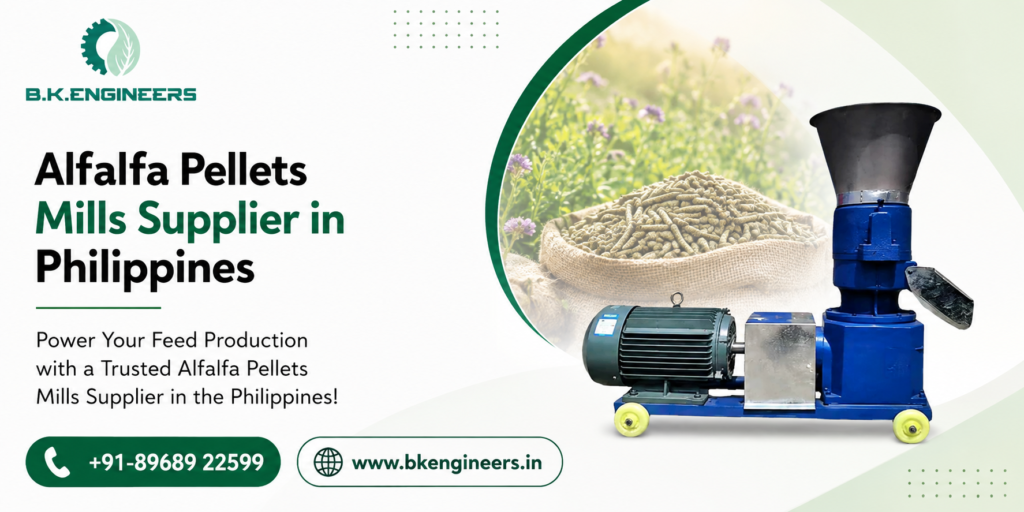
Alfalfa Pellets Mills Supplier in Philippines
Introduction
At B.K. Engineers, we specialise in manufacturing a wide range of mills designed to meet your diverse needs. Our expertise spans across Cattle Feed Mills, Poultry Feed Mills, Aquatic Feed Mills, Bran Pelleting Mills, Hull Pelleting Mills, Grass Pelleting Mills, Alfalfa Pellets Mills, Wood Pellets Mills, and Straw Pelleting Mills. With our state-of-the-art technology and commitment to quality, we ensure that you get the best equipment for your production needs.
The demand for high-quality animal feed is increasing across the Philippines as livestock and dairy farming continue to grow. Alfalfa is a valuable forage crop because it is rich in protein, fibre, vitamins, and minerals. However, converting fresh or dried alfalfa into pellets requires the right machinery. This is where a reliable Mills Supplier in the Philippines can help businesses achieve efficient and consistent feed production. We are the best Alfalfa Pellets Mills Manufacturer.
B.K. Engineers provides dependable pellet mill solutions designed for agricultural and feed-processing applications. With a focus on practical engineering, quality components, and reliable performance, the company supports businesses looking for efficient equipment for pellet production. Alfalfa pellet mills convert alfalfa into compact, uniform pellets. These are easier to handle, store, transport, and use in animal feed. For farms and feed manufacturers looking for reliable pellet production equipment, choosing the right machinery supplier is an important decision.
What Are Alfalfa Pellets
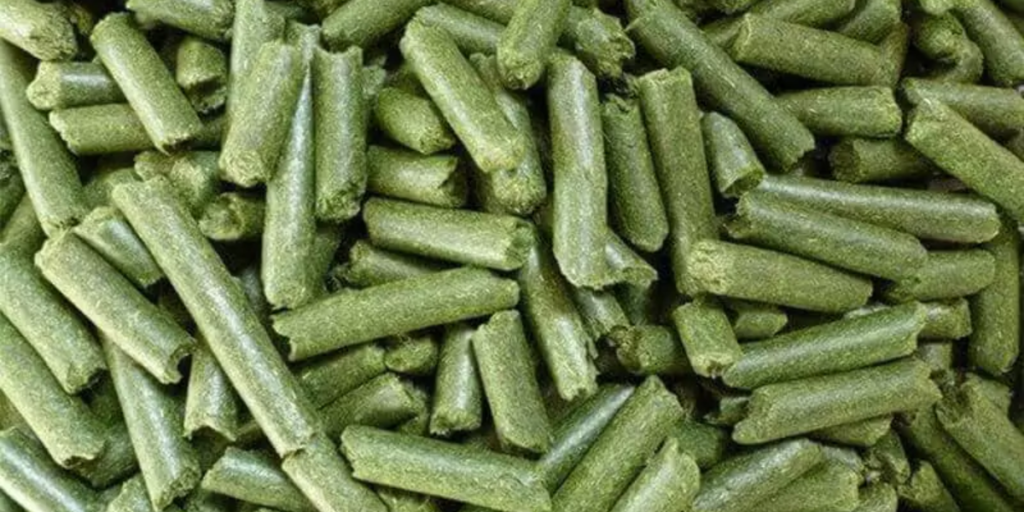
Alfalfa pellets are compact feed products made from processed is naturally rich in protein, fibre, vitamins, and minerals, making it a popular feed ingredient for different types of livestock. Pelletizing makes it easier to handle, transport, store, and feed. Compared with loose forage, it can also provide a more uniform feeding material and help reduce wastage during storage and transportation. We are the best Alfalfa Pellets Mills Provider.
The pelletizing process compresses the material into small, uniform pellets. This makes the material easier to handle and reduces problems related to loose feed. can also be stored and transported more conveniently compared with bulky raw materials. For commercial feed producers, choosing the right pellet mill is important for maintaining production efficiency and pellet quality.
Why Choose B.K. Engineers
1. High-Quality Pellet Production
- A professional Alfalfa Pellet Mills Supplier in the Philippines can provide machines designed to produce dense, uniform, and consistent pellets. Proper pellet formation helps reduce excessive fines and improves the overall handling of finished feed. Specialised pellet mills are designed to deal with the fibrous characteristics and relatively low bulk density of forage materials.
2. Better Utilisation of Alfalfa
- Loose alfalfa can require considerable storage space and can be difficult to handle efficiently. Pelletizing compresses the material into a more compact form, making it easier to convey, package, transport, and store. Industry sources identify easier transportation, longer storage potential, reduced waste, and more uniform nutrient distribution as important advantages of pellets.
3. Suitable Solutions for Different Production Capacities
- An experienced Pellet Mills Supplier in the Philippines should therefore be able to recommend equipment according to required capacity, raw-material condition, pellet size, available power, and production objectives. Complete pellet plants can incorporate processes such as bale handling, grinding, mixing, pelleting, cooling, and bagging.
4. Efficient Processing of High-Fiber Materials
- Alfalfa contains significant fibre, which can make pellet production different from processing conventional grain-based feed materials. A dedicated pellet mill is designed to provide suitable compression and feeding performance for fibrous forage.
5. Complete Feed Pellet Production Solutions
- A dependable supplier can provide more than an individual machine. For larger projects, a complete production line may include raw-material preparation, grinding, dosing, mixing, conditioning, pelleting, cooling, screening, conveying, and packaging.
6. Customisation According to Your Requirements
- Different businesses have different raw materials, production targets, pellet sizes, and plant layouts. A good Pellet Mills Supplier in Philippines should be able to recommend or configure equipment according to these requirements. Customisation may include production capacity, pellet diameter, feeding system, motor configuration, automation level, cooling system, material-handling equipment, and packaging arrangements.
7. Improved Storage and Transportation
- One of the major advantages of pelletizing is the compact form of the finished product. Compared with loose forage, pellets are easier to handle and transport. Their uniform shape also makes them suitable for automated conveying and packaging systems.
8. Reduced Feed Waste
- Uniform pellets can help reduce the handling problems associated with loose forage and improve consistency during feeding. When properly formed and cooled, they can maintain their structure during handling, packaging, and transportation. Reduced fines and improved pellet durability can help minimise material losses. This makes pellet quality an important consideration when selecting a pellet mill supplier in the Philippines.
9. Reliable and Durable Machinery
- A pellet mill is a long-term investment, so machine durability should be considered carefully. High-quality components, appropriate die and roller materials, robust transmission systems, and proper lubrication arrangements can contribute to dependable operation. A professional supplier should provide clear information about machine construction, wear parts, maintenance requirements, recommended operating conditions, and expected service intervals before installation.
10. Technical Installation and Commissioning Support
- Installing a pellet mill correctly is essential for achieving reliable production. A reputable supplier should provide technical guidance for machine installation, plant layout, electrical requirements, commissioning, and initial operation. For complete production lines, professional installation support can help ensure that conveyors, grinders, mixers, pellet mills, coolers, screens, and packing equipment operate together efficiently.
11. Easy Maintenance and Spare Parts Availability
- Regular maintenance is essential for maintaining production efficiency and extending equipment life. Pellet mills contain wear components that may eventually require inspection or replacement, particularly when processing abrasive fibrous materials. A supplier with dependable spare-parts support can help reduce unnecessary downtime. Important considerations include the availability of dies, rollers, bearings, seals, belts, motors, and other commonly required components.
12. Energy-Efficient Operation
- Energy consumption is an important operating cost for feed manufacturers. The right pellet mill should be selected according to the required production capacity and raw-material characteristics rather than simply choosing the largest available machine. A properly configured production line can help avoid unnecessary energy consumption while maintaining the required.
Applications of Alfalfa Pellets Mills
1. Dairy Cattle Feed
- One of the major applications of alfalfa pellets is dairy cattle feeding. is a protein- and fiber-rich forage and can be incorporated into cattle feeding programs as a forage source or feed ingredient. The pellet form makes it easier to measure and mix with other feed materials.
2. Beef Cattle Feeding
- Alfalfa pellets can also be used in beef cattle feeding programs where additional forage, fibre, or protein is required. The compact form reduces the handling difficulties associated with loose forage and can make feed distribution more convenient.m Pellet production allows processed forage to be incorporated into customised cattle rations. Depending on the formulation, it can be supplied alone as a forage product or combined with other ingredients.
3. Goat Feed Production
- Goat farming is another important application for pelletized forage. In the Philippines, seasonal availability of feed can create challenges for livestock raisers. Pelleting can help transform suitable forage materials into compact feed products that are easier to store and distribute. can be included in goat feeding programs as a source of forage and nutrients. A properly designed pellet mill can produce uniform pellets that support controlled feeding and easier transportation.
4. Sheep Feed
- Sheep require suitable forage and balanced nutrition for growth, maintenance, and production. Alfalfa pellets can be incorporated into sheep feeding programs as a convenient forage ingredient. The pellet format offers practical benefits for farms because it is compact and easier to handle than loose dried forage. Depending on the feed formulation, can be mixed with other feed ingredients to create a more balanced ration.
5. Horse Feed
- Alfalfa pellets are widely used in equine feeding. Their compact format makes them convenient for storage and feeding, while soaked pellets can also be used to create a soft mash when required. Horse owners and equine-feed manufacturers can use them as part of a forage-based feeding program. Pellet size and feeding quantity can be selected according to the intended application and feed formulation.
6. Rabbit and Small Animal Feed
- Alfalfa pellets are also suitable for rabbits and other small herbivorous animals. Uniform pellet sizes can help provide consistent feed portions and reduce selective feeding. Commercial small-animal feed producers can use pellet mills to manufacture pellets in different sizes according to the target animal. Pellets are commonly used in feeding programs for rabbits and other small herbivores.
7. Animal Feed Manufacturing
- Another important application is commercial animal feed manufacturing. Pellets can be used directly as a forage product or incorporated into compound feed formulations. Feed manufacturers can process it through grinding and pelleting systems to produce a more manageable feed ingredient. The pellet format can simplify storage, transportation, handling, and feed measurement.
8. Feed Supplement Production
- Alfalfa pellets can also be produced as supplementary forage products. Depending on the formulation and nutritional specifications, manufacturers can develop products intended to complement grain-based or other formulated feeds. Pellet production provides a practical way to standardise the physical form of the feed ingredient. Uniform can be packed into bags or transported in bulk, making them suitable for commercial distribution.
9. Seasonal Feed Management
- Seasonal feed availability is an important consideration for livestock producers. Philippine agricultural research has noted that feed resources can become scarce during dry periods, making feed processing and storage particularly useful. Pellets can help provide a compact, storable forage option when fresh or loose forage is less readily available. Their lower bulk volume compared with loose hay can also simplify warehouse management and transportation.
10. Feed Trading and Distribution
- The compact nature of alfalfa makes it suitable for commercial feed distribution. Pellets can be packed in different bag sizes or transported in bulk depending on the requirements of farms, distributors, and feed manufacturers. For businesses involved in importing, processing, packaging, or distributing animal feed ingredients, a dependable pellet mill can help create a consistent finished product suitable for commercial handling.
Specification Table of Alfalfa Pellet Mill
| Specification | Typical Details |
|---|---|
| Material | Alfalfa Feed Pellet Mill |
| Application | Alfalfa, Hay, Grass & Forage Pellet Production |
| Production Capacity | Approx. 0.5–8 TPH, depending on model and raw material |
| Main Motor Power | 22–250 kW |
| Ring Die Diameter | 320–762 mm |
| Pellet Diameter | 4–12 mm |
| Feeding System | Anti-bridging / Arch-breaking & Forced Feeder |
| Feeder Power | Approx. 0.75–4 kW |
| Roller System | Heavy-duty pressure rollers |
| Ring Die Material | Wear-resistant alloy / stainless steel options |
| Gear Material | 42CrMo / high-strength alloy steel |
| Pelletizing Method | Ring-die compression pelletizing |
| Drive System | Electric motor-driven |
| Pellet Application | Cattle, Dairy Animals, Sheep, Goats & Other Livestock |
| Pellet Size Adjustment | By changing ring die specifications |
| Construction | Heavy-duty industrial structure |
| Control System | Electrical control panel / customized automation |
| Power Supply | According to customer/site requirements |
Types of Alfalfa Pellet Mills
1. Flat Die Pellet Mill
- Flat die pellet mills have a simple design and are commonly used for small-scale or moderate production. They are relatively easy to operate and maintain. These machines can be suitable for farms, small feed producers, and businesses that want to begin pellet production without installing a very large production line.
2. Ring Die Pellet Mill
- Ring die pellet mills are generally designed for larger commercial production. They use a ring-shaped die and are capable of continuous pellet production when integrated into a suitable processing system. They are often preferred for industrial applications where higher production capacity and consistent pellet quality are important.
3. Electric Pellet Mill
- Electric pellet mills use an electric motor as their primary power source. They are commonly selected where a stable electrical supply is available. Electric models can be integrated into automated production systems and are suitable for various commercial and industrial pelletizing applications.
4. Heavy-Duty Pellet Mill
- Heavy-duty pellet mills are designed for demanding production environments. They generally feature stronger construction and components intended for continuous operation. These machines can be useful for commercial pellet manufacturers that require dependable performance for longer production cycles.
5. Small-Scale Alfalfa Pellet Mill
- Small-scale machines are designed for farmers, small businesses, and producers with limited production requirements. Their compact size can make installation and operation easier. They can be an economical option for businesses that are testing the market or producing pellets for their own livestock.
Conclusion
Alfalfa pellets offer a convenient way to process, handle, store, and transport forage material. With the right equipment, businesses can develop an organised pellet production process suitable for farm or commercial requirements. Choosing the right pellet mill according to raw material, production capacity, pellet size, and operating requirements can help businesses build a more efficient and dependable pellet production system. We are the best Alfalfa Pellets Mills Provider in Punjab.
B.K. Engineers offers dependable engineering and machinery solutions for agricultural and industrial applications. With its focus on quality equipment and practical solutions, the company can be a valuable partner for businesses looking to establish or improve pellet production. For reliable machinery solutions and professional assistance, B.K. Engineers is a trusted choice for businesses seeking an Alfalfa Pellets Mills Supplier in Philippines.