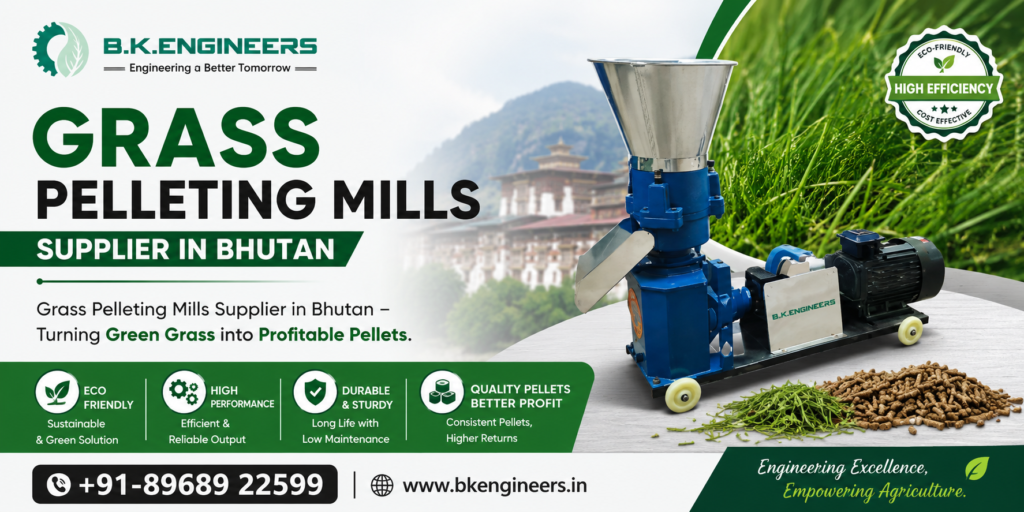
Grass Pelleting Mills Supplier in Bhutan
Introduction
At B.K. Engineers, we specialize in manufacturing a wide range of mills designed to meet your diverse needs. Our expertise spans across Cattle Feed Mills, Poultry Feed Mills, Aquatic Feed Mills, Bran Pelleting Mills, Hull Pelleting Mills, Grass Pelleting Mills, Alfalfa Pellets Mills, Wood Pellets Mills, and Straw Pelleting Mills. With our state-of-the-art technology and commitment to quality, we ensure that you get the best equipment for your production needs.
Grass is one of the most important sources of nutrition for livestock. However, storing fresh grass for a long time is difficult because it loses moisture, nutrients, and quality. This is why many farmers, dairy owners, and feed manufacturers are shifting towards grass pellets. Grass pellets are easy to store, transport, and feed to animals while maintaining their nutritional value. To make high-quality grass pellets, firms need reliable pelleting equipment. If you are searching for a reputable Grass Pelleting Mills Supplier in Bhutan, B.K. Engineers offers sophisticated grass pelleting machines built for high productivity, low maintenance, and long service life.
B.K. Engineers is your dependable manufacturing partner if you’re looking for a trustworthy supplier of grass pelleting mills in Bhutan. We offer cutting-edge grass pelleting equipment with a long service life, large production capacity, and outstanding performance. Our equipment helps companies cut waste and operating expenses while increasing productivity. Whether you own a dairy farm, poultry farm, animal business, or biomass processing center, B.K. Engineers offers complete pelleting systems adapted to your requirements. We are the best Grass Pelleting Mills Manufacturer.
What is a Grass Pelleting Mill
A Grass Pelleting Mill is a machine used to convert fresh or dried grass into compact pellets. The grass is compressed under high pressure through a die, forming uniform pellets that are easy to handle and store. Grass pellets retain essential nutrients and provide balanced nutrition for livestock. They also reduce feed wastage and improve feeding efficiency. We are the best Grass Pelleting Mills Provider.
- Longer storage life
- Easy transportation
- Reduced storage space
- Better feed management
- Less feed wastage
- Improved animal nutrition
- Higher farm productivity
- Better profitability
Grass pellets can be stored for months without losing much of their nutritional value when kept in dry conditions. The machine applies high pressure and heat through rotating rollers and dies, converting chopped grass into uniform pellets without affecting its nutritional value. Grass pellets provide animals with a consistent and nutritious feed throughout the year, even during seasons when fresh grass is limited.
Why Choose B.K. Engineers
1. High-Quality Pellet Production
A trusted supplier offers machines that produce uniform pellets with excellent density and durability. High-quality pellets improve feed consumption and reduce losses during transportation.
- Uniform pellet size
- Better hardness
- High production efficiency
- Improved feed quality
2. Durable Machine Construction
Reliable grass pelleting mills are manufactured using premium-grade steel and wear-resistant components. This ensures long machine life even under continuous production.
- Heavy-duty frame
- Hardened rollers
- Durable ring dies
- Corrosion-resistant body
- High-strength gearbox
3. Energy Efficient Performance
Modern grass pelleting mills are designed to consume less electricity while maintaining high production capacity.
- Lower operating costs
- Reduced power consumption
- High production output
- Better return on investment
4. Suitable for Different Raw Materials
A professional supplier provides machines capable of processing multiple agricultural materials such as:
- Rice straw
- Wheat straw
- Corn stalks
- Sugarcane bagasse
- Bamboo leaves
- Biomass materials
5. Advanced Pelletizing Technology
Modern grass pelleting machines incorporate advanced engineering for consistent pellet production.
- Automatic lubrication
- Variable speed control
- Temperature monitoring
- Efficient compression system
- Stable feeding mechanism
6. Low Maintenance Requirements
Choosing an experienced supplier means receiving machines that are easy to maintain.
- Easy replacement of spare parts
- Simple cleaning process
- Quick die changes
- Minimal servicing costs
7. Excellent Technical Support
A reputed Grass Pelleting Mills Supplier in Bhutan provides complete customer support, including:
- Machine installation
- Operator training
- Maintenance guidance
- Spare parts availability
- Technical troubleshooting
- After-sales service
8. Custom Machine Solutions
Different businesses have different production requirements. A professional supplier offers customized machines based on:
- Production capacity
- Available power supply
- Raw material type
- Automation level
- Budget
9. High Production Capacity
Grass pelleting mills are available in various production capacities suitable for:
- Small farms
- Medium feed plants
- Commercial feed factories
- Biomass processing industries
10. Cost-Effective Investment
Although purchasing a grass pelleting mill requires an initial investment, it offers long-term savings by reducing feed costs and improving production efficiency.
- Lower labor costs
- Reduced feed wastage
- Better storage management
- Lower transportation expenses
- Increased profitability
Applications of Grass Pelleting Mills
1. Cattle Feed Production
One of the primary applications of grass pelleting mills is manufacturing cattle feed. Bhutan has a growing dairy industry where farmers require nutritious feed throughout the year. Grass pellets provide balanced nutrition, improve digestion, reduce feed wastage, and increase milk production.
- Higher feed efficiency
- Easy storage during winter
- Better animal health
- Improved milk yield
- Reduced transportation costs
2. Sheep and Goat Farming
Grass pellets are an excellent feed option for sheep and goats. Pellets ensure every animal receives a balanced diet while minimizing selective feeding. Farmers can easily store pellets for long periods without significant nutrient loss.
- Uniform nutrition
- Better weight gain
- Easy feeding management
- Less feed wastage
3. Horse Feed Industry
Horse farms require premium-quality forage with consistent nutritional value. Grass pellets are dust-free, easy to digest, and convenient to transport, making them ideal for horse feeding programs.
- Rich in natural fiber
- Improved digestion
- Convenient storage
- Consistent feed quality
4. Poultry Feed Manufacturing
Grass meal can be blended with grains and nutritional supplements to manufacture poultry feed. The pelleting process ensures even distribution of ingredients and improves feed quality.
- Better feed conversion
- Improved bird health
- Reduced feed dust
- Uniform nutrition
5. Rabbit Farming
Rabbit farms use grass pellets because they provide the fiber necessary for healthy digestion. The pellets are easy to handle and reduce feed losses.
- Improved digestive health
- Better growth rates
- Longer shelf life
- Convenient feeding
6. Organic Livestock Farming
Organic farms in Bhutan prefer natural feed products without harmful chemicals. Grass pellets fit perfectly into organic farming practices by providing natural nutrition while preserving forage quality.
- Organic dairy farms
- Organic cattle farming
- Free-range livestock
- Sustainable agriculture
7. Feed Storage for Seasonal Use
Fresh grass is not always available throughout the year. Grass pelleting mills help convert seasonal grass into durable pellets that can be stored for months without significant deterioration.
- Long shelf life
- Protection from moisture
- Lower storage space
- Year-round feed availability
8. Biomass Fuel Production
Apart from animal feed, grass pellets are increasingly used as renewable biomass fuel. They provide a cleaner energy source for industrial boilers and heating applications, helping reduce dependence on fossil fuels.
- Renewable energy
- Lower emissions
- High energy density
- Easy transportation
9. Commercial Feed Manufacturing Plants
Large feed manufacturers use grass pelleting mills to produce commercial feed in bulk. Automated production lines improve efficiency and ensure consistent pellet quality.
- Feed processing plants
- Livestock feed manufacturers
- Dairy cooperatives
- Agricultural enterprises
10. Export-Oriented Feed Production
Bhutan’s livestock sector can benefit from producing standardized grass pellets for regional markets. High-density pellets are easier to package, transport, and export than loose forage.
- Lower shipping costs
- Longer product shelf life
- Consistent quality
- Better market value
Table Specification of Grass Pelleting Mills
| Specification | Details |
|---|---|
| Material | Grass Pelleting Mills |
| Capacity | 100–5000 Kg/Hour |
| Power Requirement | 7.5 HP – 150 HP |
| Pellet Diameter | 4 mm – 12 mm |
| Raw Material | Grass, Hay, Alfalfa, Napier Grass, Fodder |
| Material of Construction | Mild Steel / Stainless Steel |
| Roller Type | Heavy Duty Alloy Steel |
| Die Material | Hardened Steel |
| Transmission | Belt / Gear Drive |
| Moisture Requirement | 10%–15% |
| Pellet Density | High Density |
| Automation | Semi-Automatic / Automatic |
| Voltage | 415V, 50Hz, 3 Phase |
| Installation | Available |
| Warranty | As Per Company Policy |
Benefits of Grass Pelleting Mills
1. Improved Feed Quality
Grass pelleting mills produce uniform pellets that contain balanced nutrition in every bite. Animals receive the same nutrients consistently, resulting in better health and improved productivity.
- Better nutrient absorption
- Consistent feed composition
- Improved animal performance
- Healthier livestock
2. Reduced Feed Wastage
Loose grass can easily be scattered, trampled, or spoiled. Pellets significantly reduce wastage because animals consume them more efficiently.
- Less feed loss
- Cleaner feeding areas
- Better feed utilization
- Lower feeding costs
3. Easy Storage
Grass pellets occupy much less space than loose fodder due to their higher density. They are also less susceptible to moisture, pests, and mold when stored correctly.
- Reduced warehouse space
- Longer shelf life
- Easier inventory management
- Better protection against moisture
4. Lower Transportation Costs
Transporting loose grass is expensive because it occupies large volumes. Pelletized grass is compact, allowing more feed to be transported in each shipment.
- Reduced freight costs
- Higher loading efficiency
- Easier export and distribution
- Lower handling expenses
5. Better Animal Digestion
The pelleting process improves feed consistency and can enhance digestibility by making nutrients more available while reducing harmful microorganisms during processing.
- Better digestion
- Higher feed conversion
- Faster weight gain
- Improved milk production
6. Year-Round Feed Availability
Bhutan experiences seasonal changes that affect grass availability. Pelletized feed allows farmers to preserve forage during periods of abundance for use during lean seasons.
- Continuous feed supply
- Reduced seasonal shortages
- Better livestock management
- Stable production throughout the year
7. Supports Sustainable Farming
Grass pelleting mills help convert agricultural residues and forage into valuable animal feed instead of allowing these materials to go to waste.
- Napier grass
- Alfalfa
- Rice straw
- Wheat straw
- Corn stalks
8. Higher Farm Profitability
Improved feed efficiency directly contributes to higher farm income through:
- Increased milk production
- Faster animal growth
- Better reproduction
- Lower feed costs
- Reduced wastage
9. Strong and Durable Pellets
Modern pellet mills produce:
- Uniform pellet size
- High pellet density
- Low dust formation
- Strong pellet durability
10. Simple Operation
Modern grass pelleting mills are designed with user-friendly controls, making operation easy for both small farms and large feed manufacturing units.
- Easy control systems
- Automatic feeding
- Stable performance
- Low maintenance requirements
- Reliable production
Types of Grass Pelleting Mills
1. Flat Die Grass Pelleting Mill
Flat die pellet mills are suitable for:
- Small farms
- Dairy farms
- Animal feed manufacturers
- Research centers
2. Ring Die Grass Pelleting Mill
Ring die pellet mills are designed for commercial production.
- Large feed industries
- Export companies
- Commercial pellet plants
- Industrial biomass processing
3. Automatic Grass Pellet Plant
Fully automatic plants include complete production systems such as:
- Fully automated production
- Reduced labor cost
- High production efficiency
- Consistent pellet quality
- Suitable for large industries
4. Customized Grass Pelleting Machines
Every customer has different production needs.
- Raw material type
- Production capacity
- Power requirement
- Factory layout
Conclusion
The livestock industry in Bhutan continues to grow, creating a greater demand for efficient and nutritious animal feed. Investing in a high-quality grass pelleting machine is one of the smartest ways to improve feed management, reduce wastage, and increase farm profitability. We are the best Grass Pelleting Mills Provider in Punjab.
If you are looking for a dependable Grass Pelleting Mills Supplier in Bhutan, B.K. Engineers is your trusted partner. We offer advanced grass pelleting machines, customized pellet plants, and complete technical support to help your business succeed. With our commitment to quality, innovation, and customer satisfaction, we deliver reliable pelleting solutions that meet the needs of modern livestock farming.