Wood Pelleting Mills Supplier in Vietnam
Introduction
At B.K. Engineers, precision engineering is at the heart of everything we do, with your production goals guiding every decision. With over 56 years of experience and a strong commitment to quality, we work closely with you to build solutions that fit seamlessly into your operations. From complete feed mills to individual machines like hammer mills, mixers, and pellet mills, our technology supports cattle, poultry and aquatic feed production, optimising every stage of your line.
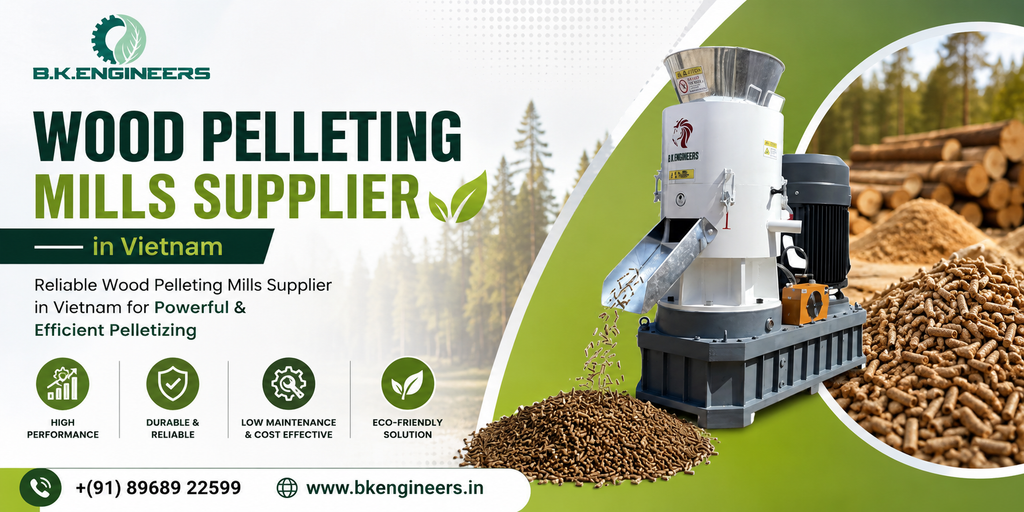
Wood pellets are becoming an important source of renewable energy for industries, commercial facilities, and heating applications. They are made by compressing wood waste, sawdust, wood chips, and other biomass materials into small, dense pellets. A reliable Wood Pelleting Mills Supplier in Vietnam can help businesses set up efficient pellet production systems according to their production requirements.
B.K. Engineers is a trusted engineering company offering reliable machinery and equipment solutions for biomass and material processing applications. With a focus on quality, performance, and practical engineering, B.K. Engineers can support businesses looking for efficient wood pelleting solutions. We are the best Wood Pelleting Mills Manufacturer.
What Is a Wood Pelleting Mills
A wood pelleting mill is a machine used to compress processed wood and biomass materials into small cylindrical pellets. The raw material is fed into the pellet mill, where pressure and controlled processing force the material through a die. The resulting pellets are then cut into the required length.
The resulting pellets are uniform in size, easy to handle, and convenient to transport and store. Wood pellet production is commonly used for biomass fuel, animal bedding, and other applications where compact biomass material is required. A professional Wood Pelleting Mills Supplier in Vietnam can provide suitable machinery based on the raw material, required output, pellet size, and operating conditions. We are the best Wood Pelleting Mills Provider.
Why Are Wood Pelleting Mills Important
Wood waste and sawdust can be difficult to store and transport in their loose form. Pelleting provides a practical way to convert these materials into a more manageable product.
- Better utilisation of wood waste
- Easy storage and transportation
- Consistent pellet size
- Improved material handling
- Higher bulk density
- Suitable for automated feeding systems
- Reduced loose biomass volume
For businesses involved in biomass processing, selecting the right pelleting equipment is important for maintaining consistent production.
Types of Wood Pelleting Mills
1. Flat Die Wood Pellet Mill
A Flat Die Wood Pellet Mill is a compact and relatively simple pelletizing machine designed mainly for small and medium-scale production. It uses a flat circular die containing multiple holes. Rollers press the prepared biomass against the die, forcing the material through the holes and forming pellets.
- Compact machine design
- Easy operation
- Lower initial investment
- Suitable for small-scale production
- Relatively simple maintenance
2. Ring Die Wood Pellet Mill
A Ring Die Wood Pellet Mill is designed for commercial and industrial wood pellet production. It uses a cylindrical ring-shaped die and pressure rollers to compress biomass through die holes. The design provides a larger effective pelletizing area and is widely used where continuous production and higher output are required.
- High production capacity
- Suitable for continuous operation
- Consistent pellet size and density
- Strong and durable construction
- Suitable for commercial pellet plants
3. Vertical Ring Die, Pellet Mill
A Vertical Ring Die Pellet Mill is another configuration used for biomass pellet production. Its vertical feeding arrangement can be helpful when processing lightweight or fibrous biomass materials.
- Continuous pellet production
- Processing of fibrous biomass
- Compact plant arrangements
- Stable pellet quality
- Commercial biomass fuel production
4. Biomass Wood Pellet Mill
A Biomass Wood Pellet Mill is designed to process various forms of biomass into fuel pellets. Depending on the machine configuration, raw materials may include sawdust, wood shavings, wood chips after suitable preparation, agricultural residues and other biomass materials.
- Sawmill waste
- Furniture factory waste
- Woodworking residues
- Planing shavings
- Fine wood particles
- Biomass fuel production
5. Industrial Wood Pellet Mill
An Industrial Wood Pellet Mill is designed for large production facilities where substantial quantities of wood pellets need to be manufactured every day. These systems are generally integrated with other equipment such as hammer mills, dryers, conveyors, coolers, screens and packing machines.
- Biomass fuel manufacturers
- Wood-processing industries
- Large sawmills
- Export-oriented pellet plants
- Industrial boiler fuel suppliers
- Renewable energy projects
Applications of Wood Pelleting Mills
1. Biomass Fuel Production
- One of the major applications of wood pelleting Mills is the production of biomass fuel. Wood waste that may otherwise have limited commercial value can be processed into dense pellets that are easier to handle, transport, store, and use. Wood pellets can be used as an alternative biomass fuel in industrial heating systems and boilers. Their compact form also makes automated feeding and material handling easier.
2. Industrial Boiler Fuel
- Wood pellets are widely suitable for industrial boilers that require a consistent biomass fuel supply. Industries such as food processing, textile manufacturing, paper production, and other manufacturing facilities can use pellet fuel for producing heat and steam. A properly designed pelleting system helps convert loose sawdust and wood residues into a standardised fuel product suitable for automated boiler-feeding systems. Industrial boilers are also identified as an important application for wood pellets in Vietnam-related pellet production projects.
3. Biomass Power Plants
- Another important application is biomass-based electricity generation. Wood pellets can be used as fuel in biomass power plants because their compact and uniform shape supports controlled feeding and combustion. A Wood Pelleting Mill Supplier in Vietnam can design a production line according to the required output capacity and raw material availability. Large-scale pellet production projects in Vietnam demonstrate the use of dedicated pellet production lines for biomass power applications.
4. Wood Processing Industries
- Vietnam has a significant wood-processing sector, which generates considerable quantities of sawdust, wood chips, shavings, bark, and other residues. Instead of treating these materials simply as waste, manufacturers can process them through a wood pelleting mill and convert them into useful biomass fuel. This creates an efficient way to utilise waste generated by sawmills, furniture factories, plywood manufacturers, timber-processing units, and other wood-related industries. Vietnam’s pellet industry itself relies heavily on residues from wood processing.
5. Sawdust Pellet Production
- Sawdust is one of the most commonly processed materials in a wood pellet plant. A pellet mill compresses properly prepared sawdust under high pressure to form dense cylindrical pellets. Before pelletizing, the sawdust may need screening, grinding, and moisture adjustment. Depending on the raw material condition, a complete production line can include a hammer mill, dryer, pellet mill, cooler, screening machine, and packing system. Vietnam-based pellet production projects have used sawdust as a key raw material.
6. Wood Chip and Wood Shaving Processing
- Wood chips and wood shavings can also be converted into pellets after suitable size reduction and moisture conditioning. A suitable crushing or grinding system prepares the material for efficient pelletizing. This application is particularly useful for sawmills and furniture manufacturers that generate large amounts of wood chips and shavings. The resulting pellets can be sold as biomass fuel or used within the manufacturer’s own heating system.
7. Renewable Energy Applications
- Wood pelleting mills support renewable-energy production by converting biomass residues into a standardised solid fuel. Wood pellets can replace or reduce the use of conventional fossil fuels in suitable heating and energy applications. For businesses looking to establish a biomass fuel plant, a complete pelleting system can help transform locally available wood residues into a commercially useful product. Vietnam’s wood-pellet sector has developed around the utilisation of wood-processing residues and has a strong export-oriented supply chain.
8. Export-Quality Wood Pellet Production
- Wood pellet production is also used to supply international biomass fuel markets. Consistent pellet size, durability, moisture, ash content, and calorific performance are important considerations when producing pellets for demanding markets. Modern pellet plants therefore require controlled processing at multiple stages. Large commercial facilities in Vietnam have invested in advanced grinding and pelletizing equipment to achieve consistent output for export markets.
9. Heating Applications
- Wood pellets can be used in pellet-fired heating equipment, including industrial and commercial heating systems. They can provide a convenient solid biomass fuel because pellets are compact and can be automatically conveyed into combustion equipment. Depending on the pellet specification and heating system, pellets may be suitable for factories, commercial facilities, and other applications requiring controlled biomass fuel feeding.
10. Agricultural and Rural Biomass Projects
- Wood residues from agricultural and rural processing activities can also be utilised in biomass pellet production when they meet the required material characteristics. A properly designed pellet plant can help convert locally available biomass into a higher-density fuel. This can create an additional revenue opportunity for businesses that generate large quantities of wood residues.
Why Choose B.K. Engineers
1. Strong Availability of Wood Raw Materials
- One of the biggest advantages of sourcing wood pelleting machinery in Vietnam is the availability of wood-processing residues. Vietnam has a large furniture and timber-processing industry, which generates substantial quantities of sawdust, wood chips, shavings, and other biomass residues. These materials can be processed and converted into valuable wood pellets instead of being wasted. Acacia and rubberwood residues are among the materials used in Vietnam’s pellet industry.
2. Advanced Pellet Production Technology
- Modern wood pelleting mills are designed to provide continuous and efficient production. A complete production line can include raw-material handling, crushing, drying, grinding, pelletizing, cooling, screening, and packing equipment. The right equipment configuration helps maintain consistent pellet size, density, moisture, and durability. Modern Vietnamese biomass facilities increasingly use automated processing and material-handling systems to improve operational efficiency.
3. Cost-Effective Manufacturing Solutions
- One of the major reasons companies consider a Wood Pelleting Mills Supplier in Vietnam is cost efficiency. Vietnam has developed a competitive biomass manufacturing and export industry, supported by local raw materials, established wood-processing infrastructure, and experienced manufacturing labour. A suitable pellet mill can provide a practical solution for businesses that want to process wood waste into a commercially useful product.
4. Efficient Use of Biomass Waste
- Wood pellets provide an effective way to convert wood-processing residues into a useful fuel product. Sawdust and other residues that might otherwise be burned or discarded can be processed into compact pellets. This creates additional value from existing biomass resources. Vietnam’s pellet industry has developed partly around converting wood-processing residues into exportable biomass fuel.
5. Consistent Pellet Quality
- Quality is extremely important in commercial pellet production. Buyers generally look at factors such as moisture content, ash content, calorific value, pellet durability, density, size, and fines. Modern pellet production systems are designed to control these parameters through proper drying, grinding, pelletizing, cooling, and screening processes. Some Vietnamese suppliers report production specifications such as approximately 6–8 mm pellet sizes, moisture levels around or below 10%, and controlled ash content depending on the grade.
6. Suitable for Export-Oriented Production
- Vietnam already has an established wood-pellet export industry. The country’s producers supply biomass fuel to international markets, with Japan and South Korea being important destinations. This means businesses purchasing pellet-mill equipment from Vietnam can benefit from suppliers familiar with export-oriented pellet production requirements.
7. Quality-Focused Production
- Pellet quality is essential for storage, transportation, handling, and combustion performance. Proper moisture control, particle-size reduction, compression, cooling, and screening are important for producing consistent pellets. A professional Wood Pelleting Mills Supplier in Vietnam can provide machinery designed to maintain stable production conditions and consistent pellet formation.
8. Complete Pelletizing Plant Solutions
- A reliable supplier should be able to provide more than just a pellet mill. A complete wood-pellet production plant may require several interconnected machines. Depending on the raw material and plant capacity, additional equipment such as conveyors, magnetic separators, dust-collection systems, silos, and automatic packing machines may also be required.
9. Better Biomass Resource Utilisation
- Pelletizing increases the density of loose biomass materials. Sawdust and wood residues are difficult to transport and store efficiently in their loose form. Pelletizing converts these materials into compact, uniform fuel products. This can make handling, transportation, storage, and automated feeding easier. Wood pellets are commonly used in industrial boilers, biomass heating systems, and power-generation applications.
10. Energy-Efficient Production Opportunities
- Energy consumption is an important part of pellet manufacturing costs. A properly designed production line can help optimise energy use through appropriate drying systems, efficient motors, suitable grinding equipment, and automated material handling. The overall efficiency depends on the raw material, moisture content, machine configuration, production capacity, and operating conditions. Therefore, businesses should discuss actual energy requirements with the supplier before finalising equipment.
11. Sustainability and Renewable Energy
- Wood pellets are produced from biomass and can support the transition toward renewable energy when the feedstock is responsibly sourced. Several Vietnamese pellet producers emphasise certified forestry sources and traceability systems. However, sustainability depends on responsible sourcing, traceability, production practices, and compliance with the requirements of the destination market. Businesses should therefore verify certifications and raw-material sources rather than relying only on general sustainability claims.
Key Reasons to Choose B.K. Engineers
- Quality Engineering:
- B.K. Engineers focuses on robust machinery and practical engineering for demanding industrial applications.
- Customized Solutions:
- Different businesses have different raw materials and production targets. Equipment can be considered according to specific requirements.
- Reliable Performance:
- Efficient machinery can help businesses maintain stable production and reduce unnecessary operational interruptions.
- Technical Support:
- Proper equipment selection is important for successful pellet production. The team can assist customers in understanding suitable machinery options.
- Industrial Experience:
- B.K. Engineers serves industrial customers with machinery solutions designed for different processing applications.
Conclusion
Wood pellet production offers an effective way to utilise wood waste and convert biomass into a compact, manageable product. A well-designed wood pelleting system can support consistent production, easier material handling, and efficient utilisation of available biomass resources. We are the best Wood Pelleting Mills Provider in Punjab.
Whether you are planning a new biomass pellet production facility or upgrading an existing operation, B.K. Engineers can help you explore suitable wood pelleting solutions for your application. B.K. Engineers provides dependable engineering and machinery solutions with a focus on quality, performance, and customer requirements.