Hull Pelleting Mills Supplier in Sri Lanka
Hull Pelleting Mills Supplier in Sri Lanka, Blogs

Hull Pelleting Mills Supplier in Sri Lanka

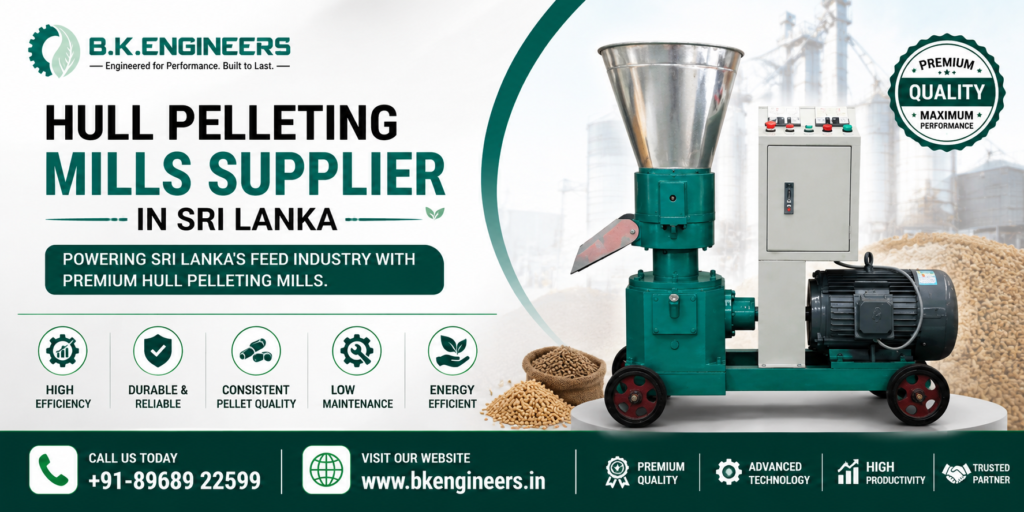
Hull Pelleting Mills Supplier in Sri Lanka Introduction At B.K. Engineers, we specialise in manufacturing a wide range of mills designed to meet your diverse needs. Our expertise spans across Cattle Feed Mills, Poultry Feed Mills, Aquatic Feed Mills, Bran Pelleting Mills, Hull Pelleting Mills, Grass Pelleting Mills, Alfalfa Pellets Mills, Wood Pellets Mills, and Straw Pelleting Mills. With our state-of-the-art technology and commitment to quality, we ensure that you get the best equipment for your production needs. The demand for biomass fuel, animal feed, and agricultural processing equipment is increasing rapidly in Sri Lanka. Businesses are looking for efficient machines that can convert agricultural waste into valuable products. One of the most important machines used for this purpose is the Hull Pelleting Mill. Suppose you are searching for a trusted Hull Pelleting Mill supplier in Sri Lanka; B.K. Engineers is your reliable partner for premium-quality pelleting machines designed to deliver outstanding performance, durability, and efficiency. B.K. Engineers is one of the leading manufacturers and suppliers of Hull Pelleting Mills, offering advanced pellet production solutions designed for high productivity and long service life. Our machines are built using modern technology and premium-quality materials to ensure smooth operation, low maintenance, and excellent pellet quality. We are the best Hull Pelleting Mills Manufacturer. B.K. Engineers is your dependable partner if you’re searching for a reputable supplier of hull pelleting mills in Sri Lanka. For a variety of industrial applications, we produce and supply top-notch hull pelleting mills that offer superior performance, longevity, and reliable pellet production. Selecting the best pelleting mill may greatly increase your production efficiency and product quality, whether you are building a new feed production facility or modernising your current equipment. What is a Hull Pelleting Mill A Hull Pelleting Mill is a specialised machine designed to convert loose agricultural materials, husks, hulls, biomass, and feed ingredients into compact pellets. The machine compresses raw materials under high pressure through specially designed dies to produce uniform pellets. These pellets are easier to store, transport, and use. They also help minimise material wastage while improving handling and feeding efficiency. Hull pelleting mills are widely used in livestock feed manufacturing, biomass fuel production, poultry feed plants, cattle feed processing, and agricultural industries. We are the best Hull Pelleting Mills Provider. The machine applies high pressure to biomass materials, converting loose waste into compact pellets without compromising quality. Hull Pelleting Mills are widely used in industries processing rice husk, coffee husk, coconut shell powder, groundnut shells, sawdust, wheat husk, and other agricultural residues. With the growing focus on renewable energy in Sri Lanka, pellet manufacturing has become a profitable investment. Why Choose B.K. Engineers High-Quality Manufacturing Standards Efficient Pellet Production Energy-Efficient Operation Custom Solutions for Different Industries Superior Pellet Quality Low Maintenance Requirements Advanced Technology and Automation Leading suppliers integrate modern technology into their pelleting mills, including automated feeding systems, temperature monitoring, pressure control, and safety mechanisms. Automation minimises manual labour, improves production accuracy, and enhances overall operational efficiency. Cost-Effective Investment Strong After-Sales Support Increased Productivity Environmentally Friendly Solution Easy Operation Reliable Performance Eco-Friendly Biomass Processing Customised Industrial Solutions Applications of Hull Pelleting Mills 1. Animal Feed Manufacturing 2. Biomass Fuel Pellet Production 3. Agricultural Waste Recycling 4. Livestock Farming 5. Oilseed Processing Industries 6. Commercial Feed Production Plants 7. Export-Oriented Biomass Pellet Industry 8. Sustainable Industrial Operations 9. Feed Processing Plants 10. Sustainable Agricultural Processing Specification Table of Hull Pelleting Mills Parameter Specification Material Hull Pelleting Mill Production Capacity 1–15 Ton/Hour Main Motor Power 22–250 kW Feeder Power 1.5–3 kW Conditioner Power 5.5–15 kW Pellet Diameter 4–12 mm Die Type Ring Die Drive System Heavy Duty Gear Drive Material Mild Steel / Stainless Steel Moisture Requirement 10–15% Lubrication System Automatic Control Panel PLC / Semi-Automatic Application Hull, Husk, Feed & Biomass Pellets Benefits of Hull Pelleting Mills 1. Increases Bulk Density Hull pelleting mills convert loose, lightweight hulls into compact pellets with higher bulk density. This significantly reduces the storage space required and allows businesses to maximise warehouse capacity while improving inventory management. 2. Reduces Transportation Costs Pelletized hulls occupy less volume than loose materials, making transportation more efficient and economical. More material can be transported in a single shipment, reducing freight expenses and improving logistics for manufacturers and exporters. 3. Converts Agricultural Waste into Valuable Products Hull pelleting mills help transform agricultural by-products into profitable products. Instead of disposing of hulls, businesses can convert them into biomass fuel pellets or animal feed ingredients, creating additional revenue streams while minimising waste. 4. Improves Material Handling Pellets are easier to convey, package, load, unload, and store compared to loose hulls. The uniform shape and size improve flow characteristics and reduce handling difficulties throughout the production process. 5. Produces High-Quality Biomass Fuel Pelletized hulls provide an efficient renewable fuel with consistent size, lower moisture, and improved combustion efficiency. They are commonly used in industrial boilers, heating systems, biomass power plants, and other energy applications. 6. Enhances Animal Feed Production Soybean hulls, sunflower hulls, and similar agricultural by-products can be pelletized for livestock feed. Pelleting improves feed consistency, reduces dust, minimizes ingredient separation, and enhances feed handling efficiency. 7. Reduces Dust Generation Loose hull materials often create excessive dust during handling and transportation. Pelletizing significantly minimizes airborne dust, resulting in a cleaner working environment, reduced product loss, and improved workplace safety. 8. Supports Eco-Friendly Manufacturing Hull pelleting promotes sustainable manufacturing by recycling agricultural residues into useful products. It reduces environmental waste while supporting renewable energy production and circular economy initiatives. 9. Delivers Consistent Pellet Quality Modern hull pelleting mills are engineered to produce pellets with uniform diameter, length, and density. This consistency improves product quality, customer satisfaction, and performance across industrial and agricultural applications. 10. High Production Efficiency Advanced pelleting systems provide continuous operation with high throughput, low energy consumption, and reliable performance. This enables manufacturers to achieve greater productivity while reducing operating costs. Types of Hull Pelleting Mills 1. Flat Die Hull Pelleting Mill Flat die pelleting mills are suitable for small-scale production.